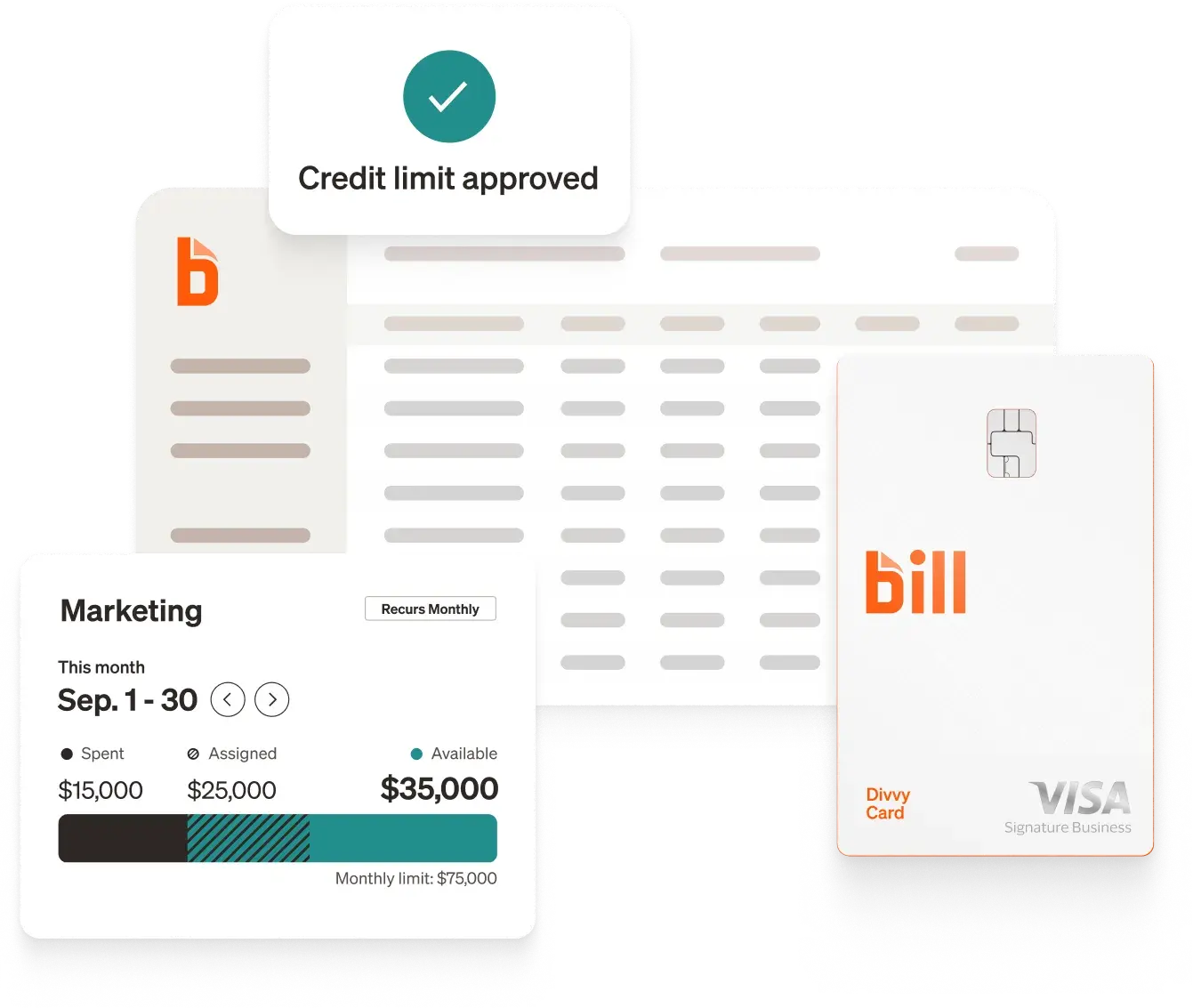
Quick answer: For small and midsize businesses, BILL is the Brex alternative to start with. It pairs spend and expense management at $0 per user[1] with AP and AR on one platform and offers a predictable credit line option[2]. BILL is trusted by more SMBs and accountants than anyone in our space: nearly half a million customers, more than 9,500 accounting firms[3]. Other options include Airbase, Navan, Mercury, and Ramp.
Brex built its name as a corporate card for venture-backed startups. Two changes have sent many finance teams looking for Brex alternatives. In June 2022, Brex stopped serving traditional small businesses[4]. Then Capital One announced a $5.15 billion agreement to acquire Brex in January 2026 and completed the deal on April 7, 2026, making Brex a Capital One subsidiary[5].
If you run finance for a product business, a professional services firm, or any company that doesn't fit a startup profile, this guide compares five Brex competitors on pricing, credit, AP and AR depth, and what users say on G2.
Brex alternatives at a glance†
Pricing and ratings are based on publicly available information as of September 30, 2026, and may change. Confirm details with each provider.
How we chose these Brex alternatives
We evaluated each platform on five criteria that matter to teams moving off Brex:
- Credit and underwriting. How limits are set and how often they change.
- Pricing and paid tiers. Per-user fees and which controls require an upgrade.
- Financial operations depth. Whether the platform covers AP, AR, and cards, or only cards and expenses.
- Integrations. Sync with QuickBooks, NetSuite, Sage Intacct, Xero, and other accounting systems.
- User reviews. Ratings and recurring themes from G2.
Top 5 Brex alternatives
1. BILL
BILL is a financial operations platform that combines spend and expense management with AP and AR. As of September 30, 2025, nearly half a million businesses use BILL to help automate their financial operations[15], and as of June 30, 2025, 8.3 million network members pay or get paid with BILL[16].
Key features
- Spend & Expense at $0 per user. Corporate and virtual BILL Divvy Cards, budgets, receipt capture, reimbursements, and reporting, with no paid tier to unlock core controls[1].
- Credit line options. BILL offers multiple credit line options that optimize cash flow or cash back, with one predictable credit line option[2].
- Mature AP and AR. Accounts payable automation with approvals, procurement, multi-entity support, W-9 and 1099 tools, and a vendor network, plus AR workflows for invoicing and collecting payments. Customers report saving 8 hours a week on AP compared to non-customers[17].
- Built-in travel. BILL Travel is part of BILL Spend & Expense, so teams can book and expense trips in one place[18].
- Cash Account. The BILL Cash Account offers a 3% APY[19] with FDIC insurance coverage up to $200M through Column N.A. and its Sweep Program Network Banks[20].
- Accounting sync. BILL integrates with leading accounting software: QuickBooks, Xero, Oracle NetSuite, Sage Intacct, and Microsoft Dynamics[21]. Customers report spending 85% less time on GL reconciliations compared to non-customers[17].
- AI. BILL's AI is trained on more than $1 trillion in transactions and more than 1.3 billion documents[22].
- International payments. BILL International Payments supports 137 countries and 106 currencies[23].
- Rewards. Points on BILL Divvy Card spend, with higher category multipliers on weekly or daily billing cycles[24].
[25]
BrüMate is one example. CFO Jarrod Cox stated that BILL Spend & Expense cut what "could be days of allocating that spend into an hour or two a month," and that the company produced nearly $400,000 worth of rewards over its relationship with BILL[24].
Pros
- Spend & Expense at $0 per user, with ERP integrations included[1]
- AP, AR, cards, and travel on one platform
- Includes a predictable credit line option[2]
- G2 reviewers frequently cite ease of use, time savings, and virtual card flexibility[7]
Cons
- AP and AR require a paid per-user subscription[6]
- Rewards carry a 12-month holding period before redemption, and category multipliers apply to the first $5,000 per month[24]
- Some G2 reviewers report integration and sync issues[7]
Ideal for: SMBs and midsize companies, especially product businesses watching cash flow, that want cards, AP, and AR in one system without per-user fees on spend management.
2. Airbase (now Paylocity for Finance)
Paylocity completed its acquisition of Airbase on October 1, 2024[26] and now sells the product as Paylocity for Finance. It combines AP automation with payments to 200+ countries, corporate cards, AI-assisted expense reports, procurement, and headcount planning connected to Paylocity's HR and payroll data[27].
Pros
- Spend data tied to the employee record, so card access and approvals can follow role changes[27]
- Procurement and AP in one workflow
- G2 reviewers frequently mention ease of use, receipt upload with automatic categorization, and accounting software integration[10]
Cons
- No published pricing; quotes are custom[9]
- Strongest when paired with Paylocity HR and payroll
- G2 reviewers cite mobile app challenges, occasional miscategorized expenses, and a desire for more customizable reporting and international support[10]
Ideal for: Midsize companies that already run Paylocity and want HR and finance data in one place.
3. Navan
Navan is a travel and expense platform that went public on Nasdaq in October 2025[28]. It pairs corporate travel booking with cards, expense management, and reimbursements.
Pros
- Travel booking free for companies with up to 300 employees[10]
- 4.7 rating from 9,000+ G2 reviews[10]
Cons
- Expense management is free for the first 5 monthly expensing users, then $15 per user per month[10]
- Built around travel, so AP and non-travel spend are less central
Ideal for: Companies where travel is the largest spend category.
4. Mercury
Mercury is a financial technology company, not a bank, that offers business checking and savings through partner banks Choice Financial Group and Column N.A.[11] It offers FDIC coverage up to $5 million through a partner-bank sweep network, subject to conditions[29], and received preliminary conditional approval from the OCC for a national bank charter in April 2026[30].
Pros
- $0 base plan with no minimums[11]
- Banking, the Mercury IO card, and bill pay in one app
Cons
- Paid plans start at $35 per month, and Mercury Pro costs $299 per month[11]
- IO card limits are tied to Mercury balances[31]
- Fewer G2 reviews (125) than other options on this list[12]
Ideal for: Early-stage startups that want a banking-first setup.
5. Ramp
Ramp is a spend management platform that pairs corporate cards with expense management, AP, procurement, and travel. It requires at least $25,000 in a linked U.S. business bank account to qualify[32].
Pros
- Free plan covers cards, expenses, and bill pay[13]
- 4.8 rating from 2,500+ G2 reviews[14]
Cons
- Ramp Plus costs $15 per user per month plus a platform fee[13]
- Starting June 1, 2026, Ramp added Bill Pay transaction fees of $0.59 per standard ACH and $1.99 per check, waived when paying from a Ramp Checking Account[33]
- Credit limits can change based on connected bank balances[34]
Ideal for: Teams that want a card-led spend platform and meet the cash requirement.
Why companies are looking for Brex alternatives
Most teams evaluating Brex competitors point to three issues.
- Ownership and roadmap. Brex now operates inside a large bank[5]. Some finance leaders want clarity on pricing, underwriting, and product priorities before signing a long-term commitment.
- Paid tiers for core controls. Brex offers a free Essentials plan, but its Premium plan costs $12 per user per month, and features such as advanced budgets, multiple expense policies, multi-entity support, and custom ERP and HRIS integrations sit in paid tiers[35].
- Credit limits tied to cash. Brex underwrites based on cash balance and/or revenue. With daily payments, a limit can reach 100% of the Brex account balance, and limits can drop if a linked bank account disconnects[36]. For companies that time vendor payments around cash flow, a limit that moves with the bank balance makes planning harder.
G2 reviewers rate Brex highly (4.8 out of 5 from more than 1,600 reviews), often praising ease of use and receipt capture. The most common complaints mention restrictive approvals and card and credit issues, and some reviewers describe the platform as built for high-growth startups rather than smaller or non-tech companies[37].
How to switch from Brex
Plan the move as a short project so no payment or subscription lapses.
- Map card-linked vendors. List each subscription and vendor charged to a Brex card and issue replacement virtual cards before closing old ones.
- Rebuild budgets and policies. Recreate approval chains and spend limits in the new platform before the cutover.
- Connect your accounting system. Set up sync with QuickBooks, NetSuite, Sage Intacct, Xero, and more and confirm your chart of accounts maps correctly.
- Run both systems briefly. Keep Brex active for a short overlap so traveling employees have a working card.
- Move AP and AR last. Once cards are stable, move vendor payments and invoicing so the back office runs in one place.
To check card eligibility, see the BILL Divvy Card requirements. For a broader look at card and expense tools, read our guide to the best expense management software.
Frequently asked questions about Brex alternatives
Does Brex still serve small businesses after the Capital One acquisition?
Brex has focused on startups and larger companies since June 2022, when it stopped serving traditional small businesses[4]. Its published requirements include a minimum cash balance for funded startups and revenue thresholds for established businesses[38]. Small businesses that don't meet those thresholds often compare BILL and Ramp instead.
Which Brex alternative has a credit line that doesn't change with my bank balance?
BILL offers multiple credit line options, including one predictable credit line option[2]. Brex and Ramp both describe limits that can change with connected bank balances[36][34]. If you schedule vendor payments around cash flow, ask each provider how often limits are reassessed.
Do I have to pay per user for budgets and expense policies?
It depends on the provider. BILL Spend & Expense is $0 per user per month[1]. Brex Premium is $12 per user per month for features such as advanced budgets and multiple expense policies[35], and Ramp Plus is $15 per user per month plus a platform fee[13].
Can one Brex alternative handle AP and AR as well as cards?
Yes. BILL combines spend and expense management with AP and AR, so vendor bills, customer invoices, and card spend sync to the same accounting system. BILL is trusted by more SMBs and accountants than anyone in our space: nearly half a million customers, more than 9,500 accounting firms[3]. As of March 2026, 98 of the top 100 US accounting firms use BILL[39].
How does BILL approach security and compliance?
BILL is a registered Money Services Business with FinCEN and is a licensed money transmitter across the United States[40]. In a 2026 survey, 97% of customers surveyed believe the BILL platform is secure[41].
Choose BILL for a Brex alternative that fits your back office
Brex remains a strong choice for many venture-backed startups. If you want cards, expenses, AP, and AR in one platform, with a predictable credit line option[2] and no per-user fees on spend management[1], compare BILL pricing and request a demo.
Disclosures
[1] BILL Spend & Expense is $0 per user per month, based on BILL's published pricing at bill.com/product/pricing as of September 2026. No annual fees for BILL Spend & Expense cards. Other fees may apply. See your Cardholder Agreement for details. Transaction or service fees may apply for certain features. See the Terms of Service for details.
[2] Credit lines and the advertised range are not guaranteed and will be determined upon application approval. Eligibility for a BILL Spend & Expense account is subject to credit approval and underwriting. Credit limits and terms, including rates and fees, may vary based on eligibility criteria. See the BILL Spend & Expense Application FAQ for more details.
[3] "In our space" refers to the SMB financial operations and spend management software category. Customer count as of September 30, 2025 (FY2026 Q1 investor deck, November 2025); accounting firm count per BILL Q2'26 investor deck.
[4] Banking Dive. Brex co-CEO: Fintech took 'reputation hit' after dropping customers.
[5] Capital One. Capital One Completes Acquisition of Brex. Accessed September 30, 2026.
[6] BILL. Pricing & Plans. Accessed September 30, 2026. Transaction fees apply to certain payment types.
[7] G2. BILL Spend & Expense (formerly Divvy) Reviews. Rating, review count, and review themes as of September 30, 2026. See also the BILL seller profile.
[8] G2. BILL AP & AR Reviews. Rating and review count as of September 30, 2026.
[9] Paylocity. Pricing. Accessed September 30, 2026.
[10] Navan. Pricing. Pricing and displayed G2 rating as of September 30, 2026.
[11] Mercury. Pricing. Accessed September 30, 2026.
[12] G2. Mercury Reviews. Rating and review count as of September 30, 2026.
[13] Ramp. Pricing. Accessed September 30, 2026.
[14] G2. Ramp Reviews. Rating and review count as of September 30, 2026.
[15] FY2026 Q1 investor deck (November 2025).
[16] FY2025 Q4 investor deck (August 2025).
[17] Based on a 2026 BILL survey comparing time spent for customers vs. non-customers.
[18] BILL Travel and the BILL Travel Agent help automate routine travel booking and expense workflows within customer-defined policies, but do not replace human judgment. Employees and admins are responsible for reviewing all trip details, applying company policies, and making final booking, change, and expense decisions. Travel services and terms are provided by third parties and may change. BILL does not provide travel, legal, tax, or accounting advice.
[19] The Annual Percentage Yield (APY) as advertised is accurate as of May 26, 2026. Interest rate and APY are subject to change at any time before and after the BILL Cash Account is opened.
[20] BILL is a financial technology company, not a bank. BILL Cash Account and banking services provided by Column N.A., Member FDIC. BILL is a financial technology company, not an FDIC-insured depository institution. FDIC deposit insurance covers the failure of an insured depository institution. Certain conditions must be satisfied for FDIC insurance to apply. Deposits in BILL Cash Accounts are FDIC-insured through Column N.A., Member FDIC and Column's Sweep Program Network Banks. No additional fees apply to opening or holding a BILL Cash Account. Other fees may be applicable to the service used or subscribed to with BILL, including but not limited to BILL account subscription fees, transaction fees, payment processing fees, and other special services fees. For more information on BILL service fees, please see the BILL Terms of Service.
[21] Based on BILL's official contracts and integrations.
[22] FY25 earnings call (November 2025); BILL AI Agents blog (October 2025).
[23] BILL International Payments website.
[24] Terms apply. Rewards rates, multipliers, holding periods, and redemption values are described at bill.com/product/rewards and may change. Individual results vary. Typical annual rewards are calculated following the BILL billing cycle.
[25] Comparison based on competitive analysis of publicly available documentation as of May 26, 2026. Terminology regarding features may vary among different vendors, potentially complicating direct comparisons. BILL is committed to diligently updating this comparison to accurately reflect any changes in the software landscape.
[26] Paylocity. Paylocity Announces Completion of Acquisition of Airbase, Inc..
[27] Paylocity. Paylocity for Finance. Accessed September 30, 2026.
[28] Navan. Navan Announces Closing of Initial Public Offering.
[29] Mercury. Understanding FDIC insurance. Accessed September 30, 2026.
[30] Office of the Comptroller of the Currency. Conditional approval decision, Mercury Bank, N.A. (April 2026).
[31] Mercury. Mercury IO. Accessed September 30, 2026.
[32] Ramp. Applying and signing up for Ramp (US-based). Accessed September 30, 2026.
[33] Ramp. Bill Pay fees. Accessed September 30, 2026.
[34] Ramp. Ramp business limits & business limit increases. Accessed September 30, 2026.
[35] Brex. Brex Pricing Plans. Accessed September 30, 2026.
[36] Brex. How Brex Credit Limits Work. Accessed September 30, 2026.
[37] G2. Brex Reviews and Brex seller profile. Rating and review count as of September 30, 2026.
[38] Brex. Brex account requirements. Accessed September 30, 2026.
[39] FY2026 Q2 investor deck; as of March 2026.
[40] BILL licenses. See bill.com/legal/authorizations.
[41] Based on a 2026 BILL survey sent to customers.
†Important disclosures: This article is for informational purposes only and is based on BILL's review of publicly available information from provider websites, G2, and reputable third-party sources as of September 30, 2026, unless otherwise noted. BILL did not independently test or audit every feature described, and actual performance and suitability will vary by business. Inclusion in this list does not constitute an endorsement, recommendation, or guarantee of results. BILL is our own product; we include it using the same evaluation criteria as other providers. This article is published by BILL.
The BILL Divvy Card may be issued by one of Divvy Pay, LLC's bank partners (bill.com/bank-partners). The BILL Divvy Card is not a deposit product. For your specific lender, see your Card Agreement.
BILL and its affiliates do not provide tax, legal or accounting advice. This material has been prepared for informational purposes only, and is not intended to provide, and should not be relied on, for tax, legal or accounting advice. You should consult your own tax, legal and accounting advisors before engaging in any transaction. BILL assumes no responsibility for any inaccuracies or inconsistencies in the content. While BILL has made every attempt to ensure that the information contained in this site has been obtained from reliable sources, BILL is not responsible for any errors or omissions, or for the results obtained from the use of this information. All information in this site is provided "as is", with no guarantee of completeness, accuracy, timeliness or of the results obtained from the use of this information, and without warranty of any kind, express or implied. In no event shall BILL, its affiliates or parent company, or the directors, officers, agents or employees thereof, be liable to you or anyone else for any decision made or action taken in reliance on the information in this site or for any consequential, special or similar damages, even if advised of the possibility of such damages.