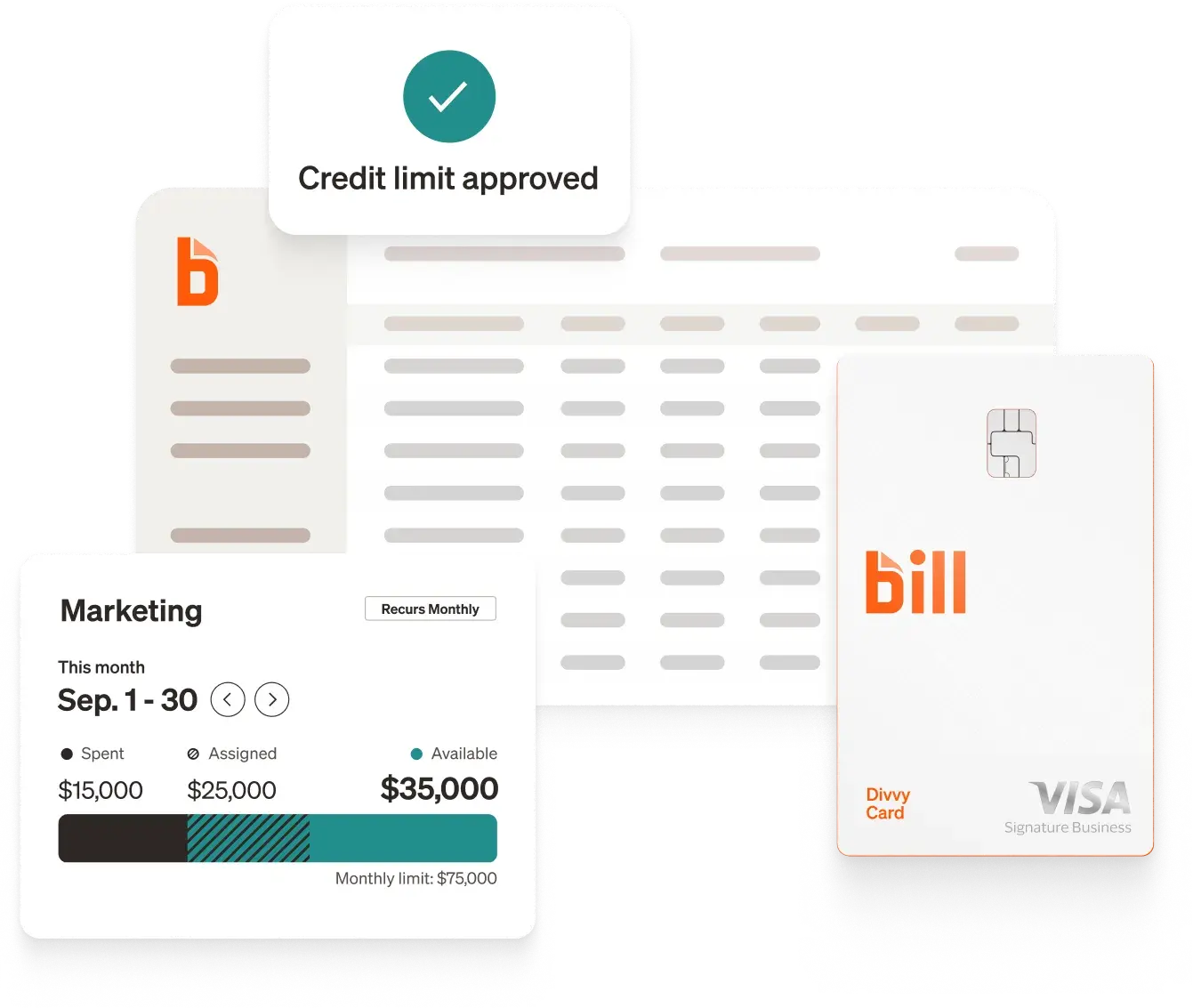
For most businesses finance teams, the first sign that expense management is broken is a stack of end-of-month receipts, a close process that runs days past deadline, and a budget that was already blown before anyone looked at the numbers. An interactive expense reporting dashboard changes that — replacing reactive reporting with real-time spend visibility, automated policy enforcement, and accounting sync that works without manual re-entry.
BILL combines accounts payable automation, corporate card spend controls, and a live expense dashboard in one platform built specifically for the way businesses actually operate.
What is an interactive expense reporting dashboard?
An interactive expense reporting dashboard is a real-time, filterable view of company spending that updates as transactions occur across employees, departments, vendors, cost centers, and time periods. Unlike static monthly reports, an interactive dashboard lets finance managers drill into specific expense categories, surface policy violations at the moment they happen, approve or reject submissions from a single interface, and export audit-ready data on demand.
Modern platforms go further: they connect to corporate card programs, accounts payable workflows, and accounting systems so that every purchase flows into the same reporting environment automatically — whether it's an employee meal receipt captured on a phone or a vendor invoice received by email.
Why "interactive" matters for businesses and finance teams
Static expense reports require someone to compile data after the fact. By the time a monthly report lands on a manager's desk, the budget may already be overspent. Interactive dashboards solve this by surfacing:
- Real-time spend vs. budget comparisons by category, team, or project
- Drill-down filtering by employee, merchant, date range, or expense type
- Automated alerts when spending approaches or exceeds set thresholds
- Policy compliance flags surfaced at the moment of transaction
- Flexible exports to PDF, CSV, or direct sync to your general ledger
How to evaluate an interactive expense reporting dashboard platform
Real-time data and drill-down reporting
The dashboard should update as transactions are authorized. Look for platforms that connect directly to your corporate card program so spend data flows in automatically, rather than waiting for employees to file expense reports.
The BILL Divvy Card integrates natively with the BILL Spend & Expense dashboard. Every transaction is categorized, applied against budgets in real time, and available for manager review without a manual submission step.
Customizable budget structures and spend controls
Finance teams need to set budgets at the department, team, project, or individual level and adjust them as business conditions change. Rigid, one-size-fits-all budget structures create workarounds that undermine visibility.
BILL lets administrators create granular spend controls by budget period, employee, merchant category, and transaction type. Limits are set proactively on the BILL Divvy Card, so out-of-policy spending is prevented rather than discovered after the fact.¹
Receipt capture and AI-powered categorization
Employees should be able to submit receipts by photo, email, or upload. The platform should extract merchant name, amount, date, and suggested GL code automatically — reducing manual entry and the errors that come with it.
BILL AI extracts data from about 220,000 documents every day,² applying smart categorization based on historical coding patterns and chart-of-accounts mapping. BILL AI recognizes patterns in your workflow and captures key invoice fields with 95% accuracy from day one.³
Approval workflows and audit trails
Multi-step approval chains, manager notifications, and complete audit trails are non-negotiable for compliance. The platform should support role-based permissions so the right people can approve the right expenses without creating bottlenecks.
BILL supports configurable multi-step approval workflows with role-based access controls. Every action — submission, approval, rejection, edit — is logged with a timestamp and user ID, creating a complete audit trail for tax season or external review.
Accounting system integration
Expense data that doesn't flow automatically into your general ledger creates reconciliation work and delays the close. Deep, native integrations are the standard to look for — not generic CSV exports.
BILL integrates natively with QuickBooks Online, QuickBooks Desktop, NetSuite, Xero, Sage Intacct, and other leading accounting platforms.⁴ In a 2026 survey, more than 80% of customers say using BILL integrations feels like adding capacity to their finance team without increasing headcount.⁵
Corporate card program
Standalone expense reporting tools require employees to use personal cards and submit reimbursement requests. Platforms with an integrated corporate card eliminate this lag entirely — spend is captured at the point of purchase.⁶
The BILL Divvy Card is built into the BILL platform, not added afterward. Finance managers can issue physical and virtual cards with pre-set spend limits, and all card activity feeds directly into the expense dashboard and accounting sync.
Interactive expense reporting dashboard platforms compared
BILL vs. Ramp vs. Expensify vs. Concur vs. Brex
The table below compares leading platforms across the criteria finance managers care most about. BILL claims reflect BILL's published comparison pages. Competitor information reflects general industry positioning as of June 2026.
Comparison based on publicly available platform information as of June 2026. Contact each vendor directly for current pricing and feature availability.
Why BILL wins over Ramp for expense reporting
Ramp has built a reputation for clean dashboards and card-based spend controls. The core distinction: Ramp's platform is built around corporate card spend. BILL's platform is built around the entire financial operations workflow — accounts payable, accounts receivable, corporate card spend, and employee expense management, all in one connected system.
For a business that only needs to control card spending, Ramp is a reasonable tool. For a business that also processes vendor invoices, manages payment approvals, handles international payments, and wants all of that flowing into QuickBooks, NetSuite, and other ERPs automatically, BILL provides a more complete solution without requiring a separate AP tool.
As of September 30, 2025, 498,000 businesses use BILL's solutions⁷, a signal that the platform has earned its place in the SMB market across diverse industries and finance team structures.
BILL's AI and automation capabilities in the expense dashboard
AI-powered invoice capture
When a vendor invoice arrives by email or is uploaded, BILL AI extracts key data fields — vendor name, invoice number, amount, due date, line items — automatically. This reduces the risk of transcription errors that lead to duplicate payments or missed early-payment discounts.
Smart categorization
BILL learns from your chart of accounts and historical coding patterns to suggest the correct GL code for each expense. Finance teams spend less time reviewing routine transactions and can focus attention on exceptions.
Automated approval routing
Rules-based approval routing sends each expense or invoice to the correct approver based on amount, department, or vendor type. BILL sends notifications via email and mobile so approvers can act without logging into the platform, keeping the workflow moving without manual follow-up.
Spend anomaly visibility
Real-time dashboards surface spending patterns that fall outside normal ranges — unusual merchant categories, amounts that exceed typical transaction sizes, or spending that accelerates unusually close to period end. Finance managers can investigate and respond before issues compound.
In FY25, BILL's AI defenses stopped over 8 million attempted fraud attacks, with potential financial exposure of more than $53 billion.⁸
Duplicate detection
BILL's automated workflows include duplicate invoice detection, flagging potential double-payments before they are processed, a common problem for businesses that receive invoices across multiple channels.
How BILL's interactive expense dashboard works in practice
For the employee: Capture a receipt photo in the BILL mobile app. BILL AI extracts the data, suggests a category, and routes the submission for approval — without manual data entry.
For the manager: Receive an approval notification, review the expense with the receipt image and policy context attached, and approve or reject in the app. No spreadsheets, no email chains.
For the finance team: The dashboard shows real-time spend by department, employee, and category. Budget utilization updates as card transactions clear and expense reports are approved. Month-end close becomes a review step, not a data-compilation project.
For the accounting team: Approved expenses and paid invoices sync to QuickBooks, NetSuite, Xero, or Sage with GL coding applied. Customers report spending 85% less time on GL reconciliations compared to non-customers.⁹ Ignite Spot Accounting now closes the books for clients who use Spend & Expense on time, every time — a shift their controller described as "almost exponential" in time efficiency. (See their story)
Who should choose BILL for expense reporting?
BILL is a strong fit for:
- businesses with 10-500 employees that need both AP automation and employee expense management in a single platform
- Finance teams using QuickBooks NetSuite and other ERPs that want expense data to sync automatically without manual export/import. Explore all BILL's integrations
- Companies issuing corporate cards that want spend controls enforced before the purchase, not discovered in monthly reconciliation
- Businesses with international vendor payments that need multi-currency support alongside domestic expense management
- Accounting firms and fractional CFOs serving multiple clients who benefit from BILL's accountant-partner program and multi-client dashboard
Product proof points
- Unified platform: BILL combines AP automation, AR automation, corporate card spend management, and expense reporting in one system, reducing the tool sprawl that creates reconciliation delays
- BILL Divvy Card: Pre-set spend limits, virtual cards, and real-time transaction data eliminate the reimbursement cycle for card-based spending⁶
- 8.3 million network members: As of June 30, 2025, 8.3 million network members pay or get paid with BILL,¹⁰ so vendor connections are often already established, reducing the friction of getting suppliers set up for electronic payment
- Native accounting integrations: BILL provides two-way integrations for 100% of the highly rated ERP and accounting platforms used by growing companies⁴
- International payments: BILL supports international payments across 137 countries and 106 currencies,¹¹ enabling companies with global vendor relationships to manage domestic and cross-border payments from the same dashboard
- Role-based access and audit trails: Every transaction, approval, and edit is logged, supporting SOC compliance and audit readiness
- Accountant network: BILL partners with more than 9,500 accounting firms in the U.S.¹² Businesses can give their external accountant or bookkeeper direct platform access, streamlining collaboration
Frequently compared expense reporting platforms at a glance
Disclosures
¹ The BILL Divvy Card may be issued by one of Divvy Pay, LLC's bank partners. The BILL Divvy Card is not a deposit product. For your specific lender, see your Card Agreement.
² BILL AI extracts data from about 220,000 documents every day. Source: BILL AI narrative document.
³ BILL AI recognizes patterns in your workflow and captures key invoice fields with 95% accuracy from day one. Data based on 1 year of invoices for key extraction fields where the field was contained in the invoice.
⁴ BILL provides two-way integrations for 100% of the highly rated ERP and accounting platforms used by growing companies. Based on G2's Accounting Software category rankings as of February 2026. "Highly rated" = top seven platforms with G2 score 4.0+, at least 800 user reviews.
⁵ In a 2026 survey, more than 80% of customers say using BILL integrations feels like adding capacity to their finance team without increasing headcount. Based on a BILL survey conducted in January 2026.
⁶ Credit lines are not guaranteed and will be determined upon application approval. The BILL Divvy Card may be issued by one of Divvy Pay, LLC's bank partners. The BILL Divvy Card is not a deposit product. For your specific lender, see your Card Agreement.
⁷ As of September 30, 2025, 498,000 businesses use BILL's solutions. Source: FY2026 Q1 investor deck (November 2025).
⁸ In FY25, BILL's AI defenses stopped over 8 million attempted fraud attacks, with potential financial exposure of more than $53 billion. Source: BILL internal risk management data for FY25.
⁹ Customers report spending 85% less time on GL reconciliations compared to non-customers. Based on a 2026 BILL survey comparing time spent for customers vs. non-customers.
¹⁰ As of June 30, 2025, 8.3 million network members pay or get paid with BILL. Source: FY2025 Q4 investor deck (August 2025).
¹¹ BILL International Payments supports 137 countries and 106 currencies. Source: BILL International Payments website.
¹² BILL partners with more than 9,500 accounting firms in the U.S. Source: BILL Q2'26 Investor Deck.
¹³ In a 2026 survey, 71% of accounting firms reclaim time by reducing manual reconciliation between BILL and their ERP. Based on a BILL survey conducted in January 2026.
BILL is a registered Money Services Business with FinCEN and is a licensed money transmitter across the United States. BILL is not a bank. Banking services, where applicable, are provided by BILL's bank partners.
The information provided on this page does not, and is not intended to, constitute legal or financial advice and is for general informational purposes only. The content is provided "as-is"; no representations are made that the content is error-free.