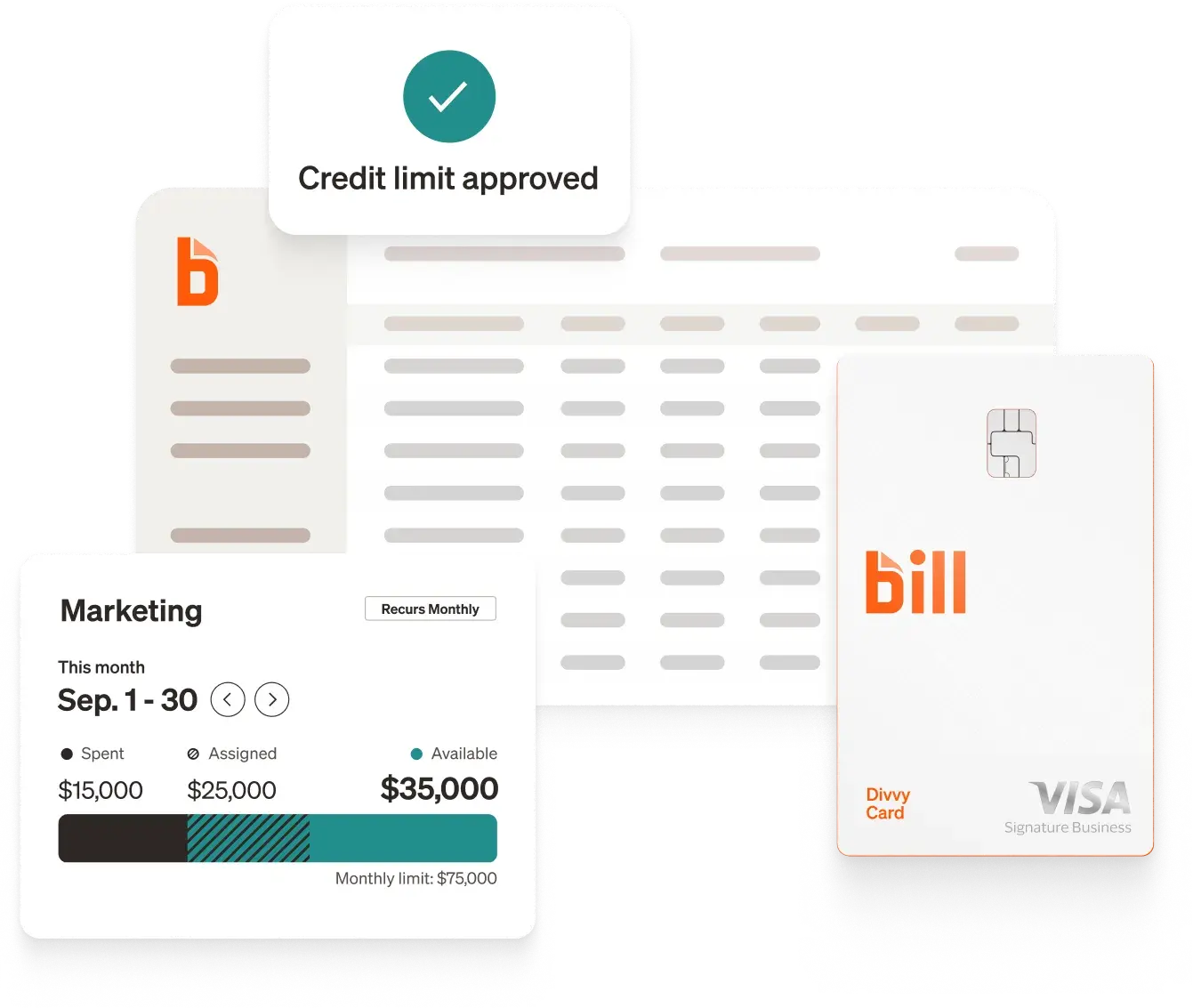
Quick answer: BILL is the Tipalti alternative to start with. It combines accounts payable (AP) automation with accounts receivable (AR) and spend and expense management on one platform, publishes its per-user pricing[1], and syncs with QuickBooks, NetSuite, Sage Intacct, Xero, and Microsoft Dynamics[2]. BILL is trusted by more SMBs and accountants than anyone in our space: nearly half a million customers, more than 9,500 accounting firms[3]. Other options include Airwallex, Coupa, and Ramp.
Tipalti is an AP automation and global payouts platform built for mid-market and enterprise finance teams. Its AP plans start at $99 per month, with per-invoice and per-payment transaction fees and add-on modules for procurement, expenses, and treasury priced on top[4]. That model works well for companies paying suppliers in many countries, but it can add up for teams that mostly pay U.S. vendors and want AP, AR, and cards in one system.
This guide compares four Tipalti competitors on pricing, payment options, AP and AR depth, ERP integrations, and what users say on G2.
Tipalti alternatives at a glance†
Pricing and ratings are based on publicly available information as of September 30, 2026, and may change. Transaction fees apply on most platforms. Confirm details with each provider.
How we chose these Tipalti alternatives
We evaluated each platform on five criteria that matter to AP teams moving off Tipalti:
- Pricing model. Platform fees, per-user fees, and per-transaction costs.
- Payments and funding. Supported payment methods and how payments are funded.
- Financial operations depth. Whether the platform covers AP only, or AP, AR, and spend.
- ERP integrations. Sync with QuickBooks, NetSuite, Sage Intacct, Xero, Microsoft Dynamics, and SAP.
- User reviews. Ratings and recurring themes from G2.
1. BILL
BILL is a financial operations platform that combines accounts payable automation with accounts receivable and spend and expense management. As of September 30, 2025, nearly half a million businesses use BILL to help automate their financial operations[12], and as of June 30, 2025, 8.3 million network members pay or get paid with BILL[13].
Key features
- End-to-end AP. Bill capture, approvals, payments, and accounting sync in one workflow. Customers report saving 8 hours a week on AP compared to non-customers[14].
- AI invoice capture. Invoice data extraction for common fields is approximately 99% accurate[15]. BILL's AI is trained on more than $1 trillion in transactions and more than 1.3 billion documents[16].
- W-9 and 1099 tools. The W-9 Agent eliminates over 80% of the steps involved in collecting and validating W-9s[17], and 1099 filing is built in.
- Flexible payment options. ACH, check, virtual card, pay by card, international wires, and local transfers, with no pre-funded payment account required[1].
- Procurement and matching. Purchase requests, purchase orders, and 2- and 3-way matching on higher-tier plans[1].
- AR and spend in the same platform. Invoicing and payment collection, plus BILL Spend & Expense at $0 per user[18].
- International payments. BILL International Payments supports 137 countries and 106 currencies[19].
- Cash Account. The BILL Cash Account offers a 3% APY[20] with FDIC insurance coverage up to $200M through Column N.A. and its Sweep Program Network Banks[21].
BILL vs. Tipalti
[23]
Vermont Flannel, a NetSuite-based apparel manufacturer paying a couple hundred vendors, is one example. CFO Colin King stated that the team went from an hours-long AP process to reviewing and completing daily AP in about 15 minutes, with BILL and NetSuite syncing in real time.
Pros
- Published per-user pricing, with ACH at $0.59 and checks at $1.99 per payment[1]
- AP, AR, and spend and expense management in one platform
- No pre-funded payment account required
- G2 reviewers frequently cite ease of use, easy payments, and easy integrations[5]
Cons
- Per-user pricing on AP/AR can add up for teams with many occasional approvers[5]
- NetSuite, Sage Intacct, and Microsoft Dynamics sync, multi-entity, and 3-way matching require the Enterprise plan[1]
Ideal for: SMBs and midsize companies, especially product businesses with high AP volume, that want AP, AR, and spend in one system with predictable pricing.
2. Airwallex
Airwallex is a global payments platform with multi-currency business accounts, cards, and bill pay. Its bill pay supports OCR invoice capture, multi-layer approvals by currency and amount, and payouts to 200+ countries[24].
Pros
- Hold and pay in 20+ currencies, with FX pricing of 0.5% above interbank for major currencies and 1.0% for others[6]
- Explore plan includes domestic and international bill pay at $0 per user[6]
Cons
- Grow is $12 per user per month plus a platform fee, and NetSuite sync starts on Grow[6]
- Smaller G2 sample (55 reviews), with some reviewers citing slow support during compliance reviews and account holds[7]
Ideal for: Companies with significant multi-currency payables that want local accounts in several markets.
3. Coupa
Coupa is a business spend management suite for large enterprises, covering procurement, AP automation, invoice matching, e-invoicing compliance, and global payments[8]. Thoma Bravo completed its acquisition of Coupa in February 2023[25].
Pros
- Deep procure-to-pay controls for complex, global organizations[8]
- G2 reviewers often cite a user-friendly interface for requesters[9]
Cons
- No published pricing; the median contract value reported by buyers on Vendr is about $94,500 per year[26]
- G2 reviewers cite complexity and a steep learning curve for configuration[9]
Ideal for: Large enterprises that need procurement, AP, and supplier management in one suite.
4. Ramp
Ramp is a spend management platform that pairs corporate cards with bill pay, procurement, and expense management. Its free plan includes AP with OCR invoice capture, approvals, and payments by ACH, card, check, or wire[10].
Pros
- Free plan covers cards, expenses, and bill pay[10]
- 4.8 rating from 2,500+ G2 reviews[11]
Cons
- Batch payments and payment release approvals require Ramp Plus at $15 per user per month plus a platform fee[10]
- Since June 1, 2026, Bill Pay transaction fees apply ($0.59 per standard ACH, $1.99 per check), waived when paying from a Ramp Checking Account[27]
- Requires at least $25,000 in a U.S. business bank account to qualify[28]
Ideal for: Card-first teams that want bill pay alongside corporate cards.
Why companies are looking for Tipalti alternatives
Tipalti earns strong marks on G2 (4.5 out of 5 from 424 reviews), with reviewers praising ease of use, helpful support, and time-saving automation[29]. Teams evaluating Tipalti competitors tend to point to four issues.
- Pricing that grows with volume and modules. Plan fees are paired with per-invoice and per-payment fees, and procurement, expenses, and treasury are add-ons[4].
- Payment funding steps. Tipalti requires pre-funding a payment account before payments are processed[23], which some teams see as an extra step in the payment timeline.
- AP-only scope. Tipalti has no native AR, so teams that invoice customers need a second system[23].
- Invoicing, reporting, and sync issues. The most common G2 complaints mention invoicing problems, delays, reporting limits, and sync issues[29].
How to switch from Tipalti
Plan the move as a phased project so no vendor payment is missed.
- Export vendor and payment data. Pull vendor records, payment details, open bills, and tax forms from Tipalti.
- Invite vendors to the new network. Vendors already on the BILL network can auto-connect, so they don't need to re-register.
- Rebuild approval rules. Recreate approval chains by amount, department, and entity before cutover.
- Connect your ERP. Set up sync with NetSuite or your accounting system and confirm GL mappings.
- Run in parallel for one payment cycle. Keep Tipalti active until the first full payment run clears in the new platform.
For more on evaluating AP tools, read our guide to the best expense management software, or see how payment approvals work in BILL.
Frequently asked questions about Tipalti alternatives
Is there a cheaper alternative to Tipalti?
It depends on your payment volume and mix. Tipalti's AP plans start at $99 per month plus per-invoice and per-payment fees[4]. BILL AP/AR plans start at $49 per user per month, with published transaction fees such as $0.59 per ACH payment[1]. Teams with few users and high domestic volume should model both.
Does BILL sync two ways with NetSuite?
Yes. BILL offers two-way sync with NetSuite, Sage Intacct, and Microsoft Dynamics on its Enterprise plan[1]. Customers report spending 85% less time on GL reconciliations compared to non-customers[14].
Can BILL handle multiple entities like Tipalti?
BILL's Enterprise plan includes multi-entity support for managing AP across entities[1]. If you run many subsidiaries across countries, confirm entity setup and approval routing during your demo.
Which Tipalti alternative covers AP and AR in one platform?
BILL combines AP and AR with spend and expense management, so vendor bills, customer invoices, and card spend sync to the same accounting system. As of March 2026, 98 of the top 100 US accounting firms use BILL[30].
Is Tipalti better for international payments?
For very broad global payouts, Tipalti covers more countries[4]. BILL International Payments supports 137 countries and 106 currencies[19]. BILL is a registered Money Services Business with FinCEN and is a licensed money transmitter across the United States[31].
Choose the Tipalti alternative that fits your AP team
Tipalti remains a strong choice for companies with high-volume global payouts. If you want AP, AR, and spend and expense management in one platform with published pricing[1], compare BILL pricing and request a demo.
Disclosures
[1] BILL. Pricing & Plans. Plan prices, plan features, and transaction fees as of September 30, 2026. Per-transaction fees apply regardless of plan.
[2] Based on BILL's official contracts and integrations.
[3] "In our space" refers to the SMB financial operations and spend management software category. Customer count as of September 30, 2025 (FY2026 Q1 investor deck, November 2025); accounting firm count per BILL Q2'26 investor deck.
[4] Tipalti. Pricing. Accessed September 30, 2026.
[5] G2. BILL AP & AR Reviews. Rating, review count, and review themes as of September 30, 2026.
[6] Airwallex. Pricing. Accessed September 30, 2026.
[7] G2. Airwallex Reviews. Rating, review count, and review themes as of September 30, 2026.
[8] Coupa. AP Automation. Accessed September 30, 2026. Coupa does not publish pricing.
[9] G2. Coupa Reviews. Rating, review count, and review themes as of September 30, 2026.
[10] Ramp. Pricing. Accessed September 30, 2026.
[11] G2. Ramp Reviews. Rating and review count as of September 30, 2026.
[12] FY2026 Q1 investor deck (November 2025).
[13] FY2025 Q4 investor deck (August 2025).
[14] Based on a 2026 BILL survey comparing time spent for customers vs. non-customers.
[15] Based on BILL's analysis of the top 20% of common bills assuming doc layouts and user behaviors stay consistent. Results will vary by invoice layout and data quality.
[16] FY25 earnings call (November 2025); BILL AI Agents blog (October 2025).
[17] Based on BILL's analysis of a typical 12-step W-9 collection process.
[18] BILL Spend & Expense is $0 per user per month, based on BILL's published pricing at bill.com/product/pricing as of September 2026. No annual fees for BILL Spend & Expense cards. Other fees may apply. See your Cardholder Agreement for details. Transaction or service fees may apply for certain features. See the Terms of Service for details.
[19] BILL International Payments website.
[20] The Annual Percentage Yield (APY) as advertised is accurate as of September 24, 2026. Interest rate and APY are subject to change at any time before and after the BILL Cash Account is opened.
[21] BILL is a financial technology company, not a bank. BILL Cash Account and banking services provided by Column N.A., Member FDIC. BILL is a financial technology company, not an FDIC-insured depository institution. FDIC deposit insurance covers the failure of an insured depository institution. Certain conditions must be satisfied for FDIC insurance to apply. Deposits in BILL Cash Accounts are FDIC-insured through Column N.A., Member FDIC and Column's Sweep Program Network Banks. No additional fees apply to opening or holding a BILL Cash Account. Other fees may be applicable to the service used or subscribed to with BILL, including but not limited to BILL account subscription fees, transaction fees, payment processing fees, and other special services fees. For more information on BILL service fees, please see the BILL Terms of Service.
[22] BILL Travel and the BILL Travel Agent help automate routine travel booking and expense workflows within customer-defined policies, but do not replace human judgment. Employees and admins are responsible for reviewing all trip details, applying company policies, and making final booking, change, and expense decisions. Travel services and terms are provided by third parties and may change. BILL does not provide travel, legal, tax, or accounting advice.
[23] Comparison based on competitive analysis of publicly available documentation as of May 26, 2026. Terminology regarding features may vary among different vendors, potentially complicating direct comparisons. BILL is committed to diligently updating this comparison to accurately reflect any changes in the software landscape.
[24] Airwallex. Bill Pay. Accessed September 30, 2026.
[25] Coupa. Coupa Software Enters into Definitive Agreement to Be Acquired by Thoma Bravo. The transaction closed February 28, 2023.
[26] Vendr. Coupa pricing. Third-party estimate based on buyer-reported deals; accessed September 30, 2026.
[27] Ramp. Bill Pay fees. Accessed September 30, 2026.
[28] Ramp. Applying and signing up for Ramp (US-based). Accessed September 30, 2026.
[29] G2. Tipalti Reviews. Rating, review count, and review themes as of September 30, 2026.
[30] FY2026 Q2 investor deck; as of March 2026.
[31] BILL licenses. See bill.com/legal/authorizations.
†Important disclosures: This article is for informational purposes only and is based on BILL's review of publicly available information from provider websites, G2, and reputable third-party sources as of September 30, 2026, unless otherwise noted. BILL did not independently test or audit every feature described, and actual performance and suitability will vary by business. Inclusion in this list does not constitute an endorsement, recommendation, or guarantee of results. BILL is our own product; we include it using the same evaluation criteria as other providers. This article is published by BILL.
The BILL Divvy Card may be issued by one of Divvy Pay, LLC's bank partners (bill.com/bank-partners). The BILL Divvy Card is not a deposit product. For your specific lender, see your Card Agreement.
BILL and its affiliates do not provide tax, legal or accounting advice. This material has been prepared for informational purposes only, and is not intended to provide, and should not be relied on, for tax, legal or accounting advice. You should consult your own tax, legal and accounting advisors before engaging in any transaction. BILL assumes no responsibility for any inaccuracies or inconsistencies in the content. While BILL has made every attempt to ensure that the information contained in this site has been obtained from reliable sources, BILL is not responsible for any errors or omissions, or for the results obtained from the use of this information. All information in this site is provided "as is", with no guarantee of completeness, accuracy, timeliness or of the results obtained from the use of this information, and without warranty of any kind, express or implied. In no event shall BILL, its affiliates or parent company, or the directors, officers, agents or employees thereof, be liable to you or anyone else for any decision made or action taken in reliance on the information in this site or for any consequential, special or similar damages, even if advised of the possibility of such damages.