Blog
  /  
BILL
  /  
BILL Launches New AI Agents for Touchless B2B Transactions

BILL Launches New AI Agents for Touchless B2B Transactions

René Lacerte
CEO and Founder of BILL
colored bill logoHeader imageHeader imageHeader imageHeader image
Table of contents
Get more from BILL
Subscribe to finance insights and thought leadership content delivered straight to your inbox.
By continuing, you agree to BILL's Terms of Service and Privacy Notice.

October 28, 2025

Closing the gap between the Fortune 500 and the Fortune 5 Million

The Fortune 500 have the tools and teams to win. The Fortune 5 Million—the small and midsize businesses driving our communities and national economy—don’t.

BILL exists to change that.

Every business deserves the people, power, and financial intelligence they need to succeed and grow. Today, we’re taking a major step toward making that a reality.

BILL has been using AI for years, and now, we’re launching BILL AI agents to give SMBs the tools and teams they need to compete and win.

Large enterprises have spent decades buying their way out of friction with more people, tools, and systems. But SMBs haven’t been able to access the same capabilities. Every day is a trade-off between speed and control; serving customers and staying on top of the books; moving forward and catching up.

Take something as simple as a W-9. Still a manual, mandatory form. Still a time sink. Still one of the biggest sources of IRS stress for businesses.

Automation was supposed to fix that. But digitizing a manual workflow is not the same as deleting it. That's where BILL AI comes in.

The problem with “more”

SMBs don’t need more AI. They need better AI built specifically for their needs. 

Too many companies are racing to pile on features. More dashboards, more chatbots, more noise.

But “more” isn’t how we define progress. True innovation isn’t about adding layers—it’s about removing limitations.

At BILL, we measure success by how much friction we eliminate, and how much opportunity we unlock. How much time we give back. How much complexity we remove. How much confidence and capability we deliver. 

Because businesses don’t need more tools or more hype.

They need less. Less work, less friction, less noise—so they can focus on what really matters: growing and winning.

That’s the future we’re building.

The future is touchless

Web apps digitized manual workflows. Agents, when built well, get rid of them. With BILL AI, we’re building towards a future of touchless B2B transactions. 

Think: A world where business operations run themselves, while people stay in control. Receipts reconcile themselves. Expenses complete autonomously. Users onboard seamlessly. Books balance automatically. Payments delivered securely and efficiently. The ability to scale capability without scaling headcount. Autonomous finance that drives at the speed of business with accuracy, reliability, and security.  

That future starts today, with some of the biggest pain points for business: W-9s and receipts.
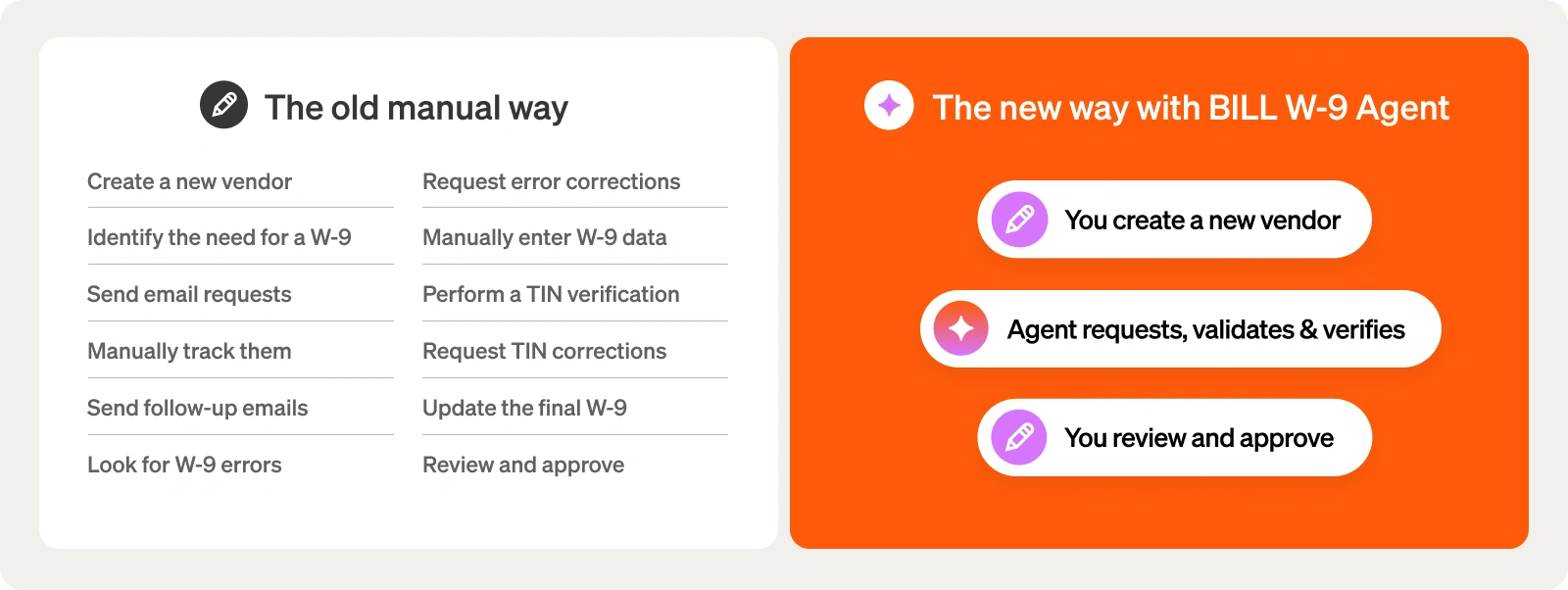
The new way with BILL W-9 Agent

Touchless tax compliance with the BILL W-9 Agent

BILL W-9 Agent is the first in the industry. It automatically requests, collects, and pre-validates W-9s—making the thing no business wants to touch, truly touchless.

More than 90% of business leaders say collecting W-9s is the most painful part of tax reporting. This agent eliminates more than 80% of the steps in the process. It has the potential to erase 650,000 hours of work to collect up to 3 million W-9s from the 1099-eligible vendors our customers do business with. 

With pre-validation, IRS stress disappears. And by Thanksgiving, the agent is expected to be available to 170,000+ businesses, making tax compliance faster, easier, and more reliable. 

W-9 Feature

Touchless receipts with the BILL Reconciliation Agent 

BILL Reconciliation Agent automatically codes transactions so receipts reconcile themselves.

Since starting to roll it out with customers, we’ve seen a 533% increase in transactions coded entirely by AI, with a more than 90% accuracy rate that will continue to improve as the agent learns from more data. 

For our Spend & Expense customers, this matters. They manage over 72 million receipts a year—the equivalent of 500 tons of paper. Our goal is simple: to ultimately make tens of millions of receipts totally touchless.

BILL Reconciliation Agent feature

Touchless setup with agentic-powered onboarding

We’re automating user onboarding for Spend & Expense, and using agentic capabilities to tailor the onboarding to each business. This new feature will automatically create virtual cards and permissions, ensuring every employee can start spending compliantly from day one.
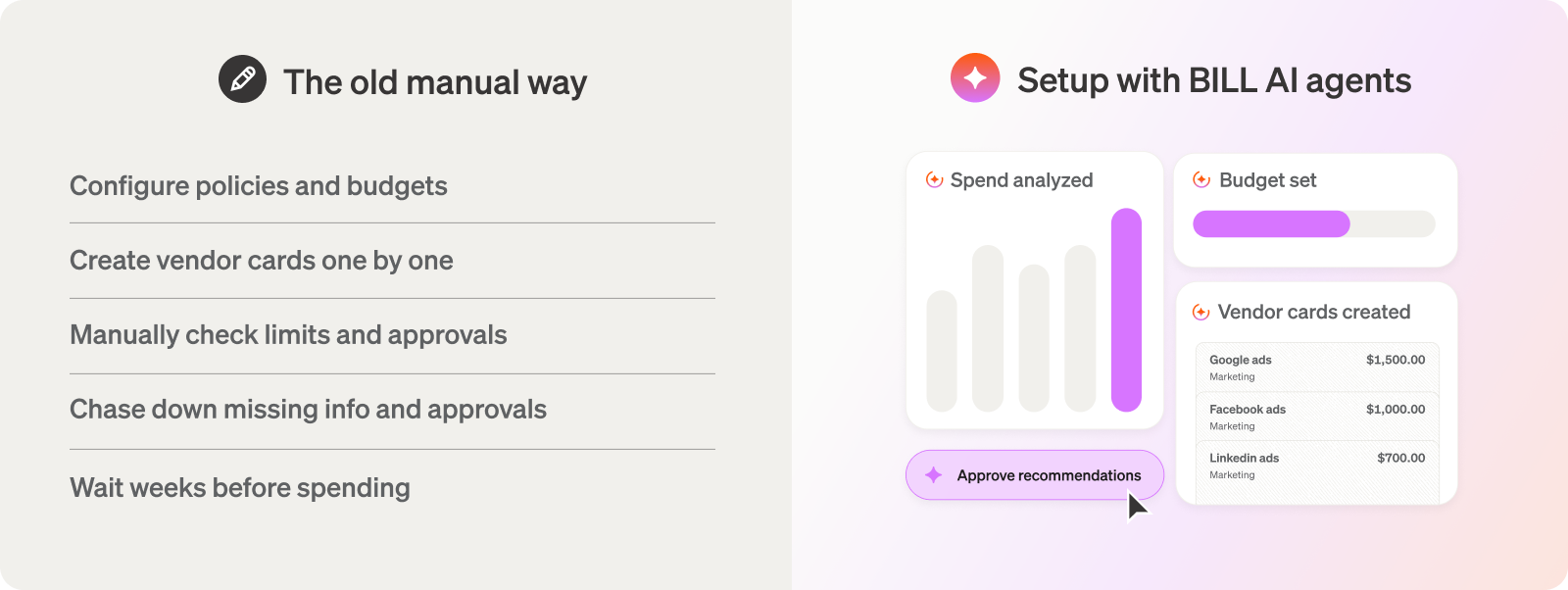
Setup with BILL AI agents

This is onboarding without the onboarding. A setup that happens behind the scenes, so new users can focus on their jobs, not their tools.

When we talk about removing friction, this is what we mean. The moment someone joins your company, they’re ready to spend, operate, and contribute.

Touchless assistance and beyond

Our agentic-powered customer experience extends that same philosophy. BILL Assistant will deliver personalized, instant answers, make intelligent recommendations, and complete tasks on behalf of customers—so they can spend less time managing the back office and more time growing their business.
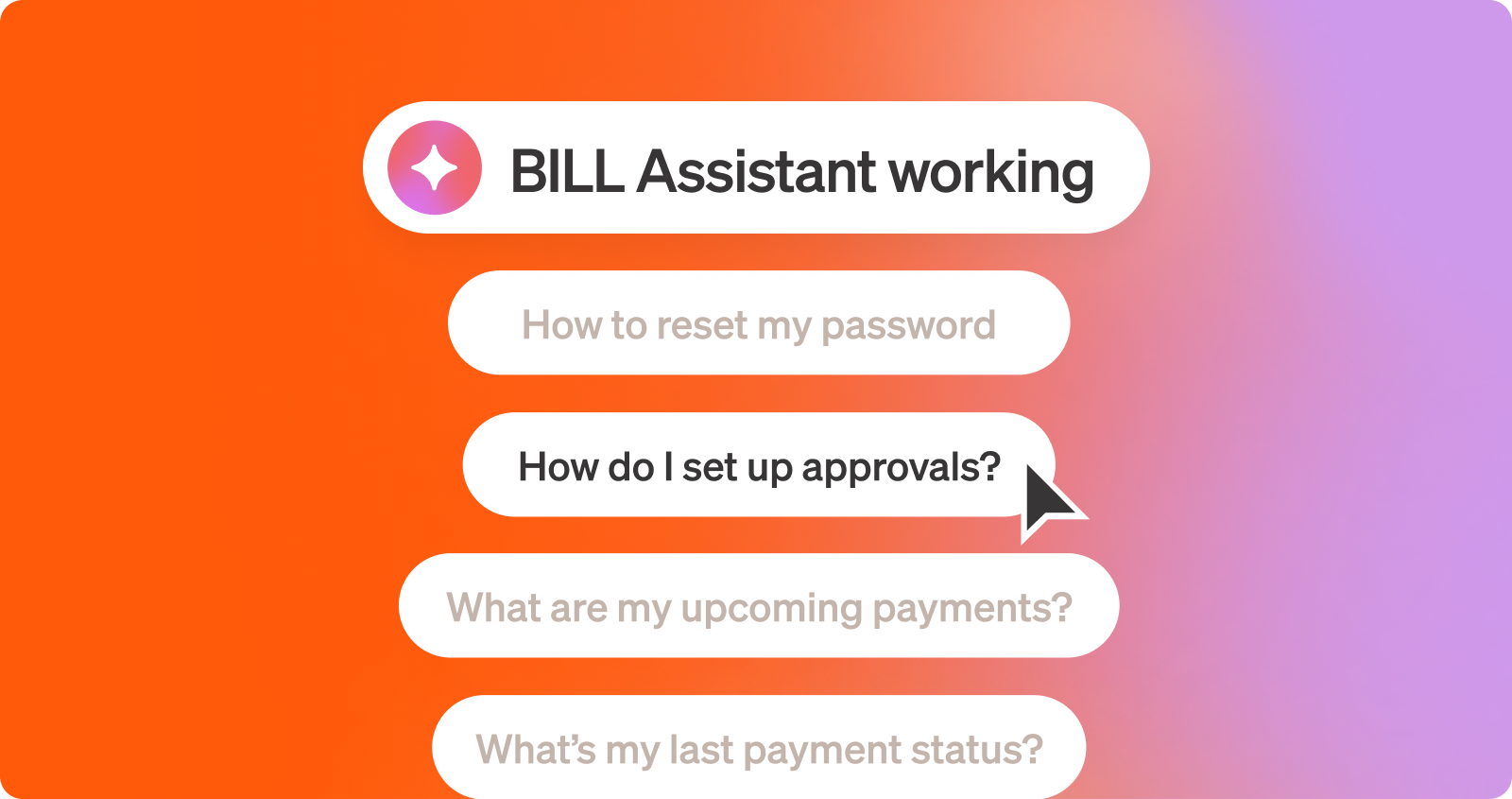
BIL Assistant working

And this is just the beginning. Next up: touchless travel, touchless email replies, touchless AP coding, and more. Every BILL AI agent is being built and trained to remove friction, save time, and unlock opportunity. 

Why BILL can build for the Fortune 5 Million

We’re trusted by more SMBs and accountants than anyone in our space—nearly half a million customers, 9,000 accounting firms. We transact ~1% of US GDP. And up to a quarter of US SMBs—8 million—are represented in our network. 

Our AI is trained on more than $1 trillion in transactions and more than 1.3 billion documents, powering smarter, faster, and more secure agents. We’ve already increased automated bills by 80% and stopped 8 million fraudulent attempts last year alone.

BILL scale and expertise

This scale, data, and trust, when combined with our unique approach to eliminating workflows, is what sets BILL apart. We’re building AI that works for SMBs—not just with them.

The future of fintech isn’t about faster workflows. It’s about making work disappear.

For the Fortune 5 Million, that future starts now.

Author
René Lacerte
CEO and Founder of BILL
René Lacerte is the CEO and Founder of BILL, the intelligent finance platform trusted by half a million businesses to manage, move, and maximize their money.
Author
René Lacerte
CEO and Founder of BILL
René Lacerte is the CEO and Founder of BILL, the intelligent finance platform trusted by half a million businesses to manage, move, and maximize their money.
Get more from BILL
Subscribe to finance insights and thought leadership content delivered straight to your inbox.
By continuing, you agree to BILL's Terms of Service and Privacy Notice.

Frequently asked questions

Dashboard mockup

Ready to bring AI to your finance team?

Take a demo with BILL to see how our integrated platform can provide your business with seamless AP, AR, and spend and expense management.

Request a Demo
The information provided on this page does not, and is not intended to constitute legal or financial advice and is for general informational purposes only. The content is provided "as-is"; no representations are made that the content is error free.

Software Comparison

BILL Spend & Expense
Best for AI expense automation
4.5 on G2
  • Smart corporate cards with real-time tracking, flexible limits, and instant visibility into every transaction across your team [1]
  • Unlimited free virtual cards with unique numbers for each vendor or subscription—freeze, delete, or set custom limits instantly to prevent overcharges and reduce fraud risk [5]
  • AI-powered auto-categorization and receipt matching that connects card transactions and expenses into a single reconciliation workflow [1]
  • Customizable budgets with spend controls based on merchant, amount, receipt requirements, and configurable approval workflows [3]
  • Auto-freeze on cards with incomplete transactions, ensuring receipts and documentation are captured before additional spend is approved [1]
  • Up to 7x points on restaurants, 5x on hotels, 2x on recurring software, and 1.5x on all other purchases (rates shown are for weekly or daily billing cycle; rates vary by billing frequency) [2]
  • Two-way sync with QuickBooks, NetSuite, Sage Intacct, Xero, and Microsoft Dynamics; additional integrations with Acumatica, Slack, and HRIS platforms [1]
  • Pro: $0/user/month with all features included—no paid tier to unlock [4]
  • Pro: Merchant controls and auto-freeze cards at no extra cost [1]
  • Pro: Credit lines that don't fluctuate daily based on bank balance [4]
  • Pro: All ERP integrations (NetSuite, Sage Intacct, Xero) included free [1]
  • Con: 12-month holding period before rewards can be redeemed [2]
  • Con: Category reward multipliers cap at $5,000/month per category [2]
  • Con: Less established in global, enterprise-scale expense programs with multi-country regulatory requirements

BILL Spend & Expense pairs corporate cards with AI-powered expense management and budget controls in a single platform at no cost—teams aren't paying per user or upgrading to unlock features that competitors gate behind paid tiers.

Merchant-level spend controls and auto-freeze on incomplete transactions give admins granular oversight without manual policing, and two-way ERP integrations are included free where Ramp and Brex charge for NetSuite and Sage Intacct access. The main trade-off is an initial 12-month rewards holding period before accumulated points can be redeemed. [1][2][3][4]

Commonly compared to: Ramp and Brex (for card-first expense management), and SAP Concur (for enterprise expense programs).

Pricing
$0/user/month with no annual fee
Integrations
Two-way sync with QuickBooks, NetSuite, Sage Intacct, Xero, and Microsoft
Ideal company size
SMB to mid-market
SAP Concur
Best for large enterprises
4 on G2
  • AI-powered receipt capture via ExpenseIt on the SAP Concur mobile app, with smart matching that combines credit card charges and e-receipts into expense reports automatically [7]
  • Configurable approval workflows with built-in audit rules that flag policy exceptions, plus optional Intelligent Audit and Verify add-ons for automated compliance checks [6][7]
  • Modular product suite: Concur Expense, Concur Travel, and Concur Invoice are separate products that can be purchased individually or together, so organizations can start with expense management and add capabilities over time [6]
  • Bank card feed integrations that import corporate card transactions directly into expense reports for automatic reconciliation [6]
  • Joule, SAP's AI assistant, for expense report review, spend analysis, and cost estimation [6]
  • Budget tracking and monitoring tools that give finance teams visibility into spend against departmental or project-level budgets [6]
  • Support for global operations with multi-currency expense reporting and country-specific tax and regulatory compliance tools [6]
  • Pro: 300+ pre-built integrations including native SAP ERP sync [7][8]
  • Pro: Global coverage with multi-currency and regulatory compliance tools [6]
  • Pro: Modular—add travel or invoice management without switching platforms [6]
  • Pro: AI-powered receipt capture and smart matching via ExpenseIt [7]
  • Con: Quote-based pricing; no published rates on the website [6]
  • Con: No corporate card offering; relies on bank card feed integrations [6]
  • Con: Implementation can be complex for smaller organizations [6]
  • Con: Live support requires purchasing the User Support Desk service [6]

SAP Concur is the incumbent in expense management software, with the largest partner ecosystem and broadest global footprint on this list. Its modular approach gives large organizations flexibility to start with expense management and layer on travel or invoice capabilities independently.

The trade-off is complexity—pricing is opaque, there's no corporate card offering, and smaller teams may find the platform more than they need. Organizations already in the SAP ecosystem will get the most value from native S/4HANA integration. [6][7][8]

Commonly compared to: BILL (for SMB expense management), and Coupa (for enterprise spend management).

  • Best for: Mid-market and enterprise organizations that need a globally scalable expense management platform with configurable compliance tools and a large partner ecosystem. [6][7][8]
  • Highlights: AI-powered receipt capture via ExpenseIt, configurable approval workflows with built-in audit rules, optional Intelligent Audit and Verify add-ons for automated compliance checks, 300+ app integrations, and native SAP ERP sync. [6][7][8]
  • Ideal if you need: An expense platform that integrates natively with SAP S/4HANA or other enterprise ERPs, with the flexibility to add modules like Concur Travel or Concur Invoice over time. [6][7]
Pricing
Quote-based
Integrations
QuickBooks, Xero, Sage,TSheets, Gusto, & most business credit cards.
Ideal Company Size
Mid-market to enterprise
Ramp
Best for a broad spend platform
4.8 on G2
  • Corporate cards with customizable spend controls by merchant, category, employee, or department, plus unlimited virtual and physical cards [9][10]
  • AI-powered receipt matching, transaction coding, and memo suggestions that auto-populate as soon as a card is swiped [9]
  • Policy agent that reviews every expense against company policy, auto-approves compliant transactions, and escalates only exceptions with full audit trail [9]
  • Expense submission via SMS, Slack, or Microsoft Teams in addition to web and mobile app [9]
  • Reimbursements for out-of-pocket expenses paid to employees' bank accounts in 1–2 business days [9]
  • Real-time spend reporting with custom dashboards, natural-language queries, and proactive overspend alerts [9]
  • Broader spend platform that includes AP automation, procurement, vendor management, and treasury alongside expense management [9]
  • Pro: Free plan includes corporate cards, expenses, and bill pay [11]
  • Pro: AI policy agent reviews 100% of expenses automatically [9]
  • Pro: Submit expenses via SMS, Slack, or Teams—no app required [9]
  • Pro: Broader spend platform covers AP, procurement, and vendor management [9]
  • Con: Budget tracking requires Ramp Plus at $15/user/month [11]
  • Con: NetSuite, Sage Intacct, and Dynamics integrations require a paid plan [11]
  • Con: HRIS syncs and auto-lock cards require a paid plan [11]
  • Con: Credit limits fluctuate daily based on connected bank balance [12]

Ramp's strength is breadth—it's not just an expense tool but a full spend management platform that includes AP automation, procurement, and vendor management alongside expenses. The AI policy agent is a differentiator, reviewing every transaction against company rules rather than relying on manual manager approvals.

The trade-off is that several features mid-market teams rely on—budget tracking, ERP integrations beyond QuickBooks and Xero, and HRIS syncs—require upgrading to Ramp Plus at $15/user/month plus a platform fee. [9][11]

Commonly compared to: Brex and BILL (for corporate cards and expense management), and SAP Concur (for enterprise expense programs).

  • Best for: Fast-growing companies that want corporate cards, expense management, and accounts payable on a single platform with AI-powered automation. [9][10]
  • Highlights: Corporate cards with built-in spend controls, AI-powered receipt matching and expense coding, a policy agent that reviews 100% of expenses and flags only exceptions, and submission via SMS, Slack, or Microsoft Teams. [9][10]
  • Ideal if you need: A card-first platform where expense management is one part of a larger system that also covers AP, procurement, and vendor management. [9]
Pricing
$0/user/month
Integrations
QuickBooks, NetSuite, Xero, Sage Intacct, Slack, & 100+ accounting tools.
Ideal Company Size
Startups to mid-market
Brex
Best for global teams
4.8 on G2
  • Corporate cards with customizable spend limits by role, department, or category, plus auto-approve for in-policy expenses and auto-decline for out-of-policy spend [13][14]
  • AI-powered expense reviews that auto-approve compliant transactions and surface only exceptions for human review, with clear visibility into why a transaction is flagged [13]
  • Auto-generated receipts and memos with OCR that matches receipts in any language or currency, plus automatic GL coding by department, project, and entity [13]
  • Live Budgets that let department heads set top-level budgets, provision spend to individuals or teams, and track usage in real time with anomaly detection [13]
  • Global reimbursements in 70+ countries in employees' local currency, with subsidiaries able to issue reimbursements from local bank accounts [13]
  • Expense submission and approval via Slack and WhatsApp, with in-app commenting on individual transactions [13]
  • Broader financial platform that includes bill pay, business banking with up to 3.68% yield, and treasury alongside expense management [14]
  • Pro: Free plan includes corporate cards, expenses, bill pay, and travel [15]
  • Pro: AI expense reviews with 99% average policy compliance rate [14]
  • Pro: Global reimbursements in 70+ countries in local currency [13]
  • Pro: Live Budgets with real-time tracking and anomaly detection [13]
  • Con: Live Budgets require Premium at $12/user/month [15]
  • Con: HRIS syncs and customizable ERP integrations require a paid plan [15]
  • Con: Credit limits fluctuate daily based on connected bank balance [16]
  • Con: Multiple expense policies and dynamic review chains require Premium [15]

Brex positions itself as a full financial stack for startups—cards, expenses, banking, and treasury in one platform. The AI expense reviews and 99% average compliance rate (per Brex's internal metrics) are notable, and the global reimbursement coverage across 70+ countries is broader than most competitors on this list.

Like Ramp, Brex gates budget management and HRIS integrations behind a paid tier, and credit limits fluctuate daily based on your bank balance. Teams that need predictable spending power or are past the startup stage may find the pricing structure adds up. [13][14][15]

Commonly compared to: Ramp and BILL (for corporate cards and expense management), and SAP Concur (for enterprise expense programs).

  • Best for: Startups and high-growth companies that want a global financial platform covering corporate cards, expense management, bill pay, and business banking. [13][14]
  • Highlights: AI-powered expense reviews that auto-approve compliant transactions, corporate cards with built-in policy controls, Live Budgets for real-time tracking, global reimbursements in 70+ countries, and OCR receipt matching in any language or currency. [13][14]
  • Ideal if you need: A financial platform built for startups that includes expense management as part of a broader stack with banking, treasury, and AP. [13][14]
Pricing
$0/user/month
Integrations
NetSuite, QuickBooks, Workday,SAP Concur, Slack, & global banking portals.
Ideal Company Size
Startups to mid-market
Expensify
Best for simple reimbursements
4.5 on G2
  • SmartScan receipt capture by photo, email forwarding (receipts@expensify.com), or text message; auto-extracts transaction details and categorizes expenses [17]
  • Bring-your-own-card support: link existing corporate cards from 10,000+ banks globally for automatic reconciliation without switching card providers [17]
  • Expensify Visa Commercial Card with cash back on US purchases; cash back first offsets the Expensify subscription cost, then flows to the company's bank account [17]
  • Concierge AI for automated expense categorization, policy violation flagging, rule enforcement, and error reduction [17]
  • Global reimbursements for employees and independent contractors in their local currency [17]
  • Chat-based collaboration directly on individual expenses to resolve questions in real time rather than through email follow-ups [17]
  • 45+ integrations including QuickBooks, NetSuite, Sage Intacct, Xero, Workday, and Gusto [17]
  • Pro: Bring-your-own-card from 10,000+ banks globally [17]
  • Pro: Expensify Card cash back can offset the subscription cost [17]
  • Pro: SmartScan receipt capture by photo, email, or text message [17]
  • Pro: 45+ integrations including major ERPs and payroll systems [17]
  • Con: No free plan; starts at $5/user/month [18]
  • Con: Pricing structure varies by card spend volume [18]
  • Con: Budget management, advanced approvals, and expense policies require Collect or Control plans [17]
  • Con: No department-level budget management on par with card-first platforms

Expensify's strength is accessibility—it has the lowest barrier to entry for teams that just need to start tracking expenses and submitting receipts. The bring-your-own-card support from 10,000+ banks means companies don't have to switch card providers, and the SmartScan receipt capture (by photo, email, or text) is one of the more flexible input methods on this list.

The trade-off is that several features mid-market teams expect—budget management, advanced approvals, and expense policies—require upgrading to the Collect or Control plans, and spend controls are primarily limited to the Expensify Card rather than extending across all connected cards. [17][18]

Commonly compared to: Zoho Expense (for budget-friendly expense management), and BILL and Ramp (for integrated cards and expenses).

  • Best for: Small and midsize businesses that want a mobile-first expense management tool with flexible card options, including the ability to link existing corporate cards from 10,000+ banks. [17]
  • Highlights: SmartScan receipt capture by photo, email, or text message; bring-your-own-card support from 10,000+ banks globally; Expensify Visa Commercial Card with cash back that offsets subscription costs; and Concierge AI for automated categorization and policy enforcement. [17]
  • Ideal if you need: A lower-cost entry point for expense management where employees can start submitting receipts immediately without switching corporate card providers. [17]
Pricing
From $5/user/month
Integrations
QuickBooks, Xero, Sage, TSheets, Gusto, & most business credit cards.
Ideal Company Size
Small to mid-market
Zoho Expense
Best for budget-conscious teams
4.5 on G2
  • Autoscan receipt capture with OCR that auto-categorizes and itemizes each expense, plus the ability to split or tag expenses across departments, projects, or cost centers [19][20]
  • Automated per diem calculations with pre-defined rules based on country, location, and trip details for regional compliance [20]
  • Corporate card management with real-time feeds that automatically match transactions to uploaded receipts for faster reconciliation [20]
  • Mileage tracking with four input methods across Android, iPhone, and Apple Watch [20]
  • Configurable approval workflows, expense policies, and audit rules with detailed audit trails for compliance [19][20]
  • Custom modules, workflow automation, webhooks, and configurable UI elements for businesses that need tailored expense processes [19]
  • Active-user pricing model: only employees who actually create expenses are charged, so admins and approvers who don't submit reports are free [21]
  • Pro: Free plan available for up to 3 users with core expense tracking [21]
  • Pro: Active-user pricing—admins and approvers aren't charged [21]
  • Pro: Automated per diem calculations by country and location [20]
  • Pro: Deep customization with custom modules and workflow automation [19]
  • Con: Corporate card feeds and multi-level approvals require Standard plan [21]
  • Con: Deepest value requires the broader Zoho ecosystem (Books, People, CRM) [19]
  • Con: No corporate card offering; relies on connecting existing cards [20]
  • Con: Travel booking, per diem, and live budgets require Premium plan [21]

Zoho Expense offers unusually deep customization at a low price point—custom modules, workflow automation, webhooks, and configurable UI elements that most competitors don't expose. The active-user pricing model is genuinely cost-effective for companies where only a portion of employees submit expenses regularly.

The trade-off is that there's no corporate card offering—you'll need to connect your existing cards—and the platform delivers its deepest value when used alongside other Zoho products like Zoho Books and Zoho People. [19][20][21]

Commonly compared to: Expensify (for budget-friendly expense management), and SAP Concur (for global compliance and customization).

  • Best for: Small and midsize businesses that want an affordable, highly customizable expense management platform with strong global compliance features and active-user pricing. [19][20][21]
  • Highlights: Autoscan receipt capture with OCR, automated per diem calculations by country and location, corporate card reconciliation with real-time feeds, mileage tracking across multiple input methods, and active-user pricing starting at $4/user/month. [19][20][21]
  • Ideal if you need: A low-cost expense management tool with deep customization options and native integration with the broader Zoho ecosystem (Zoho Books, Zoho People, Zoho CRM). [19][20]
Pricing
Free (3 users); from $4/user/month
Integrations
Zoho Books, QuickBooks, Xero, Sage, Microsoft Dynamics, & Google Workspace.
Ideal Company Size
Small to mid-market