
Advisors for Change helps nonprofits see the reality of financial possibility

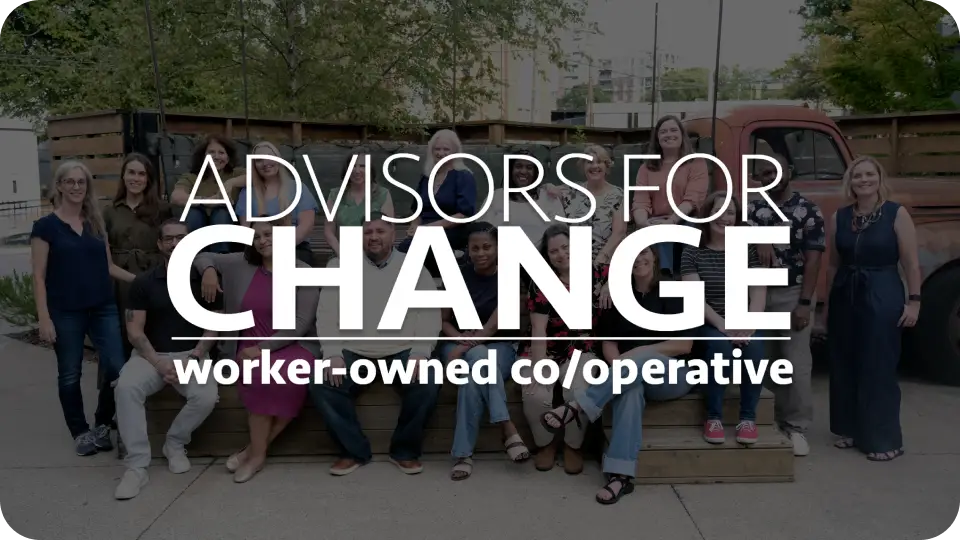
Advisors for Change is a worker-owned cooperative that partners with nonprofits to strengthen financial management through collaborative, people-first systems and support.
advisorsforchange.com
Industry
Company Size
20 FTEs serving 70 nonprofits at a time
Headquarters
Denver, Colorado
Customer since
2021
Solutions
Products
- ACH
- Pay by Card
- Virtual Card
- Ad Spend Rewards
- International Payments
- Local Transfer
- 1099
- Gmail Integration
- Lyft Integration
- BILL Divvy Card in AP
- W-9 Agent
- Invoice Coding Agent
- Transaction Agent
- Multi-Entity
- Procurement
Accounting Software
Nonprofits exist to serve their communities, but too many of them are weighed down by financial operations that don’t keep pace with their missions. Staff without accounting backgrounds might need to manage books. Paper-based workflows often create bottlenecks. And many leaders spend too much time chasing invoices and reconciling receipts. Advisors for Change (AFC) steps into these gaps, and BILL is the platform that makes the transformation work.
Advisors for Change is an employee-owned cooperative that provides transformational financial management services exclusively to nonprofits. Legally registered in Denver, Colorado, and fully remote with a team of 20 employees spread across the country, AFC serves approximately 50 nonprofit organizations at any given time. Their partners span a wide range of missions, from legal aid for domestic violence survivors to housing, the arts, and wildlife conservation.
What sets AFC apart is its engagement model which works to build financial capacity from within each organization, by making assessments, supporting capacity building, recommending software, coaching leadership, and strengthening internal controls, so that nonprofits can eventually manage their own financial operations independently.
Krystal Thompson is Senior Software Solutions Advisor at AFC. With 15 years of accounting experience spanning nonprofit consulting, manufacturing and education, she oversees the software implementations that AFC recommends to its partners. Her role is to evaluate each organization's workflows, identify gaps, and guide teams through onboarding to new systems. BILL, she says, has become the most important piece of AFC's technology stack after QuickBooks Online.
Problem: Fragmented manual processes holding nonprofits back
Most nonprofits that engage with AFC arrive with financial operations built around paper, a regular habit, and whoever happens to be available. Thompson sees similar patterns across nearly every new engagement.
Paper-based accounts payable and check-signing bottlenecks
Many AFC partners arrive with accounts payable workflows built entirely around paper. Thompson describes one recent partner whose process captured this problem in full.
"They have their purchase orders mailed, staple their invoice to it, make a copy of the purchase request and staple that, and then send the payment off, make a copy of the check, add that to the paper, file it away," Thompson says.
When auditors arrived, the consequences of that manual process became clear. Locating documentation tied to specific payments took days. Receipts went missing. Staff members who had made purchases had since left the organization, taking any institutional knowledge with them. What should have been routine financial oversight became a constant source of stress and interruption for already overstretched teams. Instead of supporting the mission, financial processes were consuming emotional energy and staff capacity.
Shared credit cards with no controls
On the expense side, the picture is equally constrained. A company might use a corporate credit card where one person checks the card out, makes a purchase, and returns it, leading to receipts being submitted weeks later.
"They have their executive director who has their credit card and they have a sign-out sheet,” Thompson says. “And if you need it, you have to make sure it gets approved, and the approval is you getting the card.”
The result is a lack of visibility into individual spending, no real-time budget controls, and a heavy mental load on the executive director to track every transaction.
Over-reliance on one person for financial operations
In small to midsize nonprofits, staff routinely wear multiple hats. People without accounting backgrounds end up managing accounts payable, reconciliations, and vendor payments. That concentration of responsibility in a single person creates risk and potential for fraud as no checks and balances or segregation of duties: when that person is absent, overloaded, or leaves the organization, financial operations grind to a halt.
Thompson sees this as a structural challenge, not a personnel failure. AFC designs workflows that make financial knowledge transferable, so organizations are not dependent on a single employee to keep operations running.. But, that only works when the right tools are in place to support it.

Solution: A phased rollout that builds confidence and capacity
AFC introduces technology in phases so nonprofit teams can build confidence without disrupting day-to-day operations. Rather than overwhelming nonprofit teams with a full platform at once, Thompson introduces BILL in phases, starting with the most pressing pain point and expanding as the organization builds confidence.
Starting with Accounts Payable proves the value
For the partner with the fully manual process, AFC started by onboarding four top executives into BILL Accounts Payable as a first phase. The team created a workflow map within the platform, assigned approval roles, and began with low-risk recurring bills such as utilities and other predictable expenses,so the team could see the system work without disrupting critical operations.
The results came quickly. Within three weeks, the partner’s bookkeeper reclaimed three hours per week.
"It actually took three hours a week in the first month away from their bookkeeper,” Thompson says. “She no longer had to do AP two days a week. She only had to do it one day a week.”
Expanding to Spend & Expense once confidence is established
Once the partner saw the time savings from BILL Accounts Payable, they were open to tackling the shared credit card problem. About three months later, AFC introduced BILL Spend & Expense. The executive director's reaction during the demo captured the shift.
"The executive director says, 'So everybody can have their own card.' And at that moment, I knew it was a win," Thompson says. "It was that moment of: ‘I can still have the control that I need and the confidence to empower my employees to do the things I need them to do without the mental load.’”
Within a week and a half, four staff members had their own BILL Divvy cards2. When one employee traveled and came back with every receipt submitted at the point of purchase, the executive director reached a turning point.
A platform that adapts to the way each nonprofit works
Across AFC's portfolio, Spend & Expense serves a wide range of use cases. A nonprofit bakery uses it to support multiple delivery drivers. A wildlife animal refuge relies on it for in-person supply purchases. Another partner uses 100% virtual cards for online purchases, pre-booked travel, and recurring expenses. Reimbursements have been particularly valuable for nonprofits that need to reimburse approved expenses or manage per diem and travel-related spending within a documented approval workflow.
Thompson points to the AP Spend feature which allows users to pay bills through Accounts Payable using their Spend & Expense card and earn rewards.
"Every less click that you have to do in Spend & Expense saves you more than you know," Thompson says. "I'm very big on saving one minute at a time."
AI-powered features that reduce transaction time to seconds
Thompson has been an early adopter of several AI-powered features within BILL. On the accounts payable side, she uses the AI auto-coding feature for invoice entry and has found it reliably accurate. On the Spend & Expense side, auto-categorization is enabled for most AFC partners. Combined with the Gmail integration and auto-matching, these features have transformed transaction processing into something Thompson can demonstrate in real time during partner training.
"Between the Gmail integration, auto-matching, and auto-coding,” Thompson says. “It's truly a one-stop shop. I have a screen recording of me submitting a receipt and it takes me seconds*. There's just no excuse after that."
The W-9 Agent takes the pressure off tax season
AFC recently rolled out the BILL W-9 Agent with several partners during tax season. For a team that spends significant time tracking down vendor W-9 forms and matching taxpayer identification numbers, the automation provides immediate relief.
"That definitely saves our team at least an hour a day* of searching through TIN matching, making sure that vendors had their W-9s submitted," Thompson says.
QuickBooks sync that eliminates reconciliation busywork
AFC also uses QuickBooks Online internally and recommends it to most partners. The sync between BILL and QuickBooks eliminates what Thompson describes as a significant portion of the reconciliation workload, matching payment statements, credit card expenses, and statement reconciliations across systems.
"The sync eliminates a significant amount of manual reconciliation work, giving teams more time for higher-value financial oversight.,” Thompson says. “That's an underrated time saver."
International payments that replaced daily bank trips
One AFC partner conducted roughly half of its business internationally and processed multiple international wires each day. Staff had to visit two different banks at different times to complete transfers and confirm positive pay on each transaction. Once BILL expanded its international payment capabilities, the process shifted from being one person's full-time job to a streamlined workflow within the platform.
Results: From financially aware to financially fluent
Since Thompson joined AFC four years ago, BILL adoption across the client base has grown from roughly 30% to up to 85%*, as reported by Thompson. The platform is now a core part of every financial management engagement, and the impact reaches well beyond any single feature or time savings metric.
- Nonprofit teams that previously depended on a single person for financial operations now distribute responsibilities across multiple staff members with defined roles and approval workflows
- AFC's internal team spends less time on manual support tasks like W-9 tracking and reconciliation, freeing capacity to serve more partners
- Audit readiness has shifted from a scramble to locate paper documentation to a searchable, centralized digital record accessible from anywhere
- Executive directors and nonprofit leadership report reduced stress and greater confidence in their organizations' financial controls
The long-term goal is operational independence: systems that continue working even after AFC steps away.
For Thompson, the most meaningful results show up in the moments when nonprofit leaders realize how much has changed. For example, a bookkeeper who no longer has to dedicate two days a week to accounts payable, or an executive director who can trust her staff with their own cards.
One partner celebrated the transition in a way Thompson will not forget.
"She literally had a manila folder that just said 'receipts' that she would keep in her purse,” Thompson says. “On our last day, we had a ceremonial ripping of the receipt folder and she shredded it right in front of me. It was both a physical and a mental release."
Asked to describe BILL in one word, Thompson chose "transformative."
"It really creates an opportunity for people to not only change how they approach the work that they do, but also the tools that they use to do that work," she says. "It's not just a change in physical habit of learning to use new software. It challenges you to change your approach so you can spend more time doing other things."
What’s next for Advisors for Change
AFC is in the middle of building its next 5-year strategic plan, and technology integration is at the center of the vision. Rather than recommending individual tools in isolation, the team is working toward a holistic approach that maps the full journey from financial confusion to clarity and using BILL as a foundational piece of that guidance.
On the product side, AFC is testing the BILL 1099 integration with two partner organizations and is in an internal beta of the procurement module, which Thompson sees as a strong fit for nonprofit partners who need purchase request approvals and automatic invoice matching. Thompson herself is shifting her role from hands-on technical implementations toward business development and marketing by attending conferences, spreading the word about AFC's approach, and reaching new types of organizations that could benefit from the same kind of financial transformation.
*Results as reported by Advisors for Change based on internal analysis of workflows across clients using the BILL Platform May 2026. Results are based on the experience of a specific customer and are not a guarantee of future performance. Actual results will vary. 2The BILL Divvy Card may be issued by one of Divvy Pay, LLC’s bank partners (bill.com/bank-partners). The BILL Divvy Card is not a deposit product. For your specific lender, see your Card Agreement.


Ready to bring AI to your finance team?
Take a demo with BILL to see how our integrated platform can provide your business with seamless AP, AR, and spend and expense management.