Blog
  /  
Business Basics
  /  
12 tips for small business cash flow management

12 tips for small business cash flow management

Andrew Scarcella
Contributing writer, BILL
illustrated button and cursor with the words business basicsHeader imageHeader imageHeader imageHeader image
Table of contents
Get more from BILL
Subscribe to finance insights and thought leadership content delivered straight to your inbox.
By continuing, you agree to BILL's Terms of Service and Privacy Notice.

Smart small business cash flow management is the bedrock for long-term, sustainable growth. That means converting sales into cash as quickly as possible, while reducing and extending your payments, to build a cash cushion. How? Here are 12 tips for how to improve cash flow management and position your business for growth.

1. Forecast cash flow

The first step for effective cash flow management is forecasting. AKA predicting how much cash will go in and out of your business—next month, next quarter, and next year. The more accurate your cash flow forecasting, the better you'll be able to plan for future cash shortages. 

Say you have a large equipment repair next month that's likely to impact your ability to pay your bills. By implementing cash flow forecasting, you'll have enough time to plan and rein in your expenses or even look into leveraging a small business line of credit to ensure you'll have the proper cash flow to keep your business running. Even with the large payment.

Whether you do your cash flow forecasting manually with a spreadsheet or use a financial planning tool, the key is making sure you account for ALL cash inflows and outflows. From anticipated sales revenue, investments, and receivables collections to salaries, rent, inventory purchases, and loan payments. More accurate inputs make more accurate forecasts.

Consider how BILL customer, Q Foundation, leveraged improved visibility into its financial data for better cash flow forecasting and money management. 

Brian Basinger, Founder and Executive Director, explains.

“We built a system where lawmakers can get a clear view of exactly who's getting funding and where it's going. It shows how we establish community-based equity targets, and then how we're meeting those targets. Because they can see results, they keep giving us money.” 

Better visibility, and thereby better cash flow forecasting, has also made easier work of securing funding—and easier reporting to lawmakers. Absolutely essential for a non-profit like Q Foundation.

2. Invoice promptly

Not staying on top of invoicing is a common mistake small business owners make. Putting off sending invoices means your customers can't pay you, which can lead to cash shortages.

Invoicing cadence can vary quite a lot based on your credit terms and particular business or industry norms. The most common cadences are: 

  • Weekly
  • Bi-weekly
  • Monthly
  • On milestones
  • Once work is completed or product delivered

But whatever your invoicing cadence is, you should consider automation to streamline the process and sync with your accounting or invoicing software. The easier you can make the process, the less likely you are to put it off.

3. Manage receivables

Profitable companies can still experience cash flow issues due to having too much revenue tied up in receivables instead of their bank accounts. But by staying on top of their receivables, management of cash flow is that much easier.

The key to effectively managing receivables is enforcing payment terms and following up on late payments. Consider offering incentives for on-time or early invoice payments, like a discount for paying within a week. Alternatively, you can try deterrents, like fees or interest for late payments. 

Chronically late-paying customers might necessitate requiring up front payments instead of extending credit to make sure you get paid.

4. Control spending

Reining in your spending should always be a go-to for managing cash flow. Sure, you have to spend money to make money sometimes. But saving money is often just as effective. 

Whenever you're considering spending money on your business, take a look at your expenses with an investment mindset before you commit. Take a step back and consider whether the expenditure will boost revenue, reduce costs elsewhere, or even improve efficiency. 

An easy example is new hires. Will another employee bring in more sales or bring new skills to the company? Will they reduce workload so you can focus on long-term growth? 

3 more ways to control business expenses:

  1. Make a budget and stick to it
  2. Work with suppliers to negotiate better prices or discounts
  3. Use automation to streamline tasks and free up time

5. Keep inventory in check

Keeping inventory in check by avoiding over or understocking can help you save money, reduce waste, and help you improve your small business cash flow management.

Use inventory management tools to track levels in real time, notify you when supplies are low, or automate orders so you never run out. 

6. Negotiate payment terms

Negotiating with your vendors for more favorable terms is a solid strategy to improve your cash flow. If your current agreement is net 30, consider asking for net 60 or 90. Especially if you have a long-standing relationship with the vendor. 

Alternatively, you could ask to have late fees waived. When done with respect and directness, negotiating new payment terms isn't as daunting as it may seem.

Always reach out early, well before payments are due. Last minute requests for new terms are poor form and no one likes to be rushed.

Think about what your vendors will get from the renegotiated terms. Increased order volume for improved cash flexibility, perhaps?

And remember to aim high, but be reasonable. Negotiations are all about give and take.

7. Know your tax obligations

Small business cash flow management is difficult enough even without factoring in tax obligations. Surprise tax bills can create cash crises if you're not prepared. 

The remedy is maintaining accurate bookkeeping, making estimated tax payments, and filing your returns on time. Keep a close eye on your tax obligations—like sales, excise, and payroll tax—to save yourself from unnecessary penalties or fines.

When in doubt, turn to your accountant or tax professional to help estimate your tax obligations so you have the cash on hand to cover your tax payments.

8. Regularly monitor cash flow

We already talked about why cash flow forecasting is important. But just as important is regularly monitoring your cash flow so you can update that forecast.

Because when market conditions, costs, and goals change, so can your cash flow. 

Enter a statement of cash flows, which outlines how your cash position has changed over the last month, quarter, or year. 

By preparing and reviewing your statement of cash flows on a regular basis, you can easily see any potential cash flow issues early. So you can make adjustments before they get out of hand.

Want a real world example? See how apparel manufacturer Bombas used cash flow visibility to predict and plan for success

9. Leverage tech

If your budgeting, accounting, and financial reporting is still in spreadsheets that need to be updated manually, managing cash flow is going to be tough and time-intensive. 

That's why financial tech tools are so quickly being adopted by small businesses to make managing their cash flow easier.

Using accounting software to digitize data entry is the first step. Next is implementing automation platforms to streamline budget controls, track expenses in real time, automate preparation of financial reports, and provide financial planning insights.

Want a real world example? Here's one from Merchant e-Solutions, who use BILL Accounts Payable to simplify their payments and calm the chaos. 

“BILL has made our payment process pain free,” says Lori Brown, SVP and corporate controller. “We now pay our bills in a timely manner and that’s improved our cash flow and enhanced our reputation with our vendors. At this point, I don’t know what I’d do without it.”

10. Establish a cash reserve

Prepare your business for unexpected costs or disruptions by establishing a cash reserve.

Three to six months of operating expenses is a good place to start. But the amount of money you'll want to set aside should be based on your specific business, industry, and financial obligations. 

If that seems like a lot right now, don't worry. Start by setting a goal to have one month of operating expenses in your business savings account and go from there. As your financial health improves, increase your goals and keep building your cash reserves.

Even a modest cash reserve can make weathering unexpected challenges without negatively impacting your cash flow easier.

11. Over-communicate with customers

Over-communication should be the rule when billing customers. Make sure to add notes like "payment expected upon invoice receipt" and "interest charged for all payments later than 30 days" to invoices with your customers when you bill them to avoid any confusion. 

Want to find where problems are coming from? Do some digging. Running a report to categorize accounts receivable according to how long invoices are outstanding can aid in identifying chronically late or delinquent payers.

Another real world example comes from Niche, who used real-time cash flow oversight to improve their vendor relationships. 

12. Ask for help

Don't be afraid of asking for assistance. As a small business owner, cash flow management can be overwhelming, especially as you're seeking to implement new best practices. Reach out to an accountant or bookkeeper for help or answers to questions about budgeting, forecasting, and cash flow management.

Need more working capital to cover payroll, accounts payable, or other unexpected expenses? Consider applying for a line of credit or a bank loan to tide you over as you continue to improve your cash flow.

A preview of the BILL Cash Flow Forecasting Dashboard

Next level cash flow management for small businesses

Maintaining positive cash flow is critical to your ‌success. With these tips, you can stay on top of your finances and better plan for the future.

BILL's financial operations platform can help you create and pay bills, send invoices, manage expenses, control budgets, and access the credit your business needs to grow—all on one platform. And with BILL Insights and Forecasting, you can predict future cash flow, uncover trends and opportunities, and maximize your business potential.

Merchat eSolutions knows the impact firsthand.

“BILL has made our payment process pain free. At this point, I don’t know what I’d do without it.” - Lori Brown, SVP and Corporate Controller at Merchant e-Solutions

Request a live demo or start your risk-free trial today to see how BILL can help you improve your small business cash flow management.

For a broader perspective, you can also check out The Strategy Shift: How Today’s Leaders Master Cash Flow, a free three-part virtual series exploring how finance leaders are strengthening visibility, efficiency, and control.

Small business cash flow management FAQs

How much cash flow is good for a small business?

Three to six months of operating expenses is a great goal. But even one month is a good start you can build on over time.

What is an example of a cash flow in a small business?

Cash flows both into and out of small businesses every day. Purchasing inventory is cash outflow. Selling that inventory is cash inflow. Paying workers or utility bills? Out. Getting a loan or business credit line? In. 

What percentage of small businesses fail due to cash flow?

According to SCORE, 82% of small businesses fail due to cash flow problems.1 However, cash flow is just one metric. How much money is flowing into and out of a business can't definitively predict if a business is succeeding or failing.

1The #1 Reason Small Businesses Fail - And How to Avoid It, SCORE, 2023

Author
Andrew Scarcella
Contributing writer, BILL
Andrew is a writer and producer whose creations span research reports, educational video series, in-depth interviews, and the occasional TV commercial.
Author
Andrew Scarcella
Contributing writer, BILL
Andrew is a writer and producer whose creations span research reports, educational video series, in-depth interviews, and the occasional TV commercial.
Get more from BILL
Subscribe to finance insights and thought leadership content delivered straight to your inbox.
By continuing, you agree to BILL's Terms of Service and Privacy Notice.

Frequently asked questions

Dashboard mockup

Ready to bring AI to your finance team?

Take a demo with BILL to see how our integrated platform can provide your business with seamless AP, AR, and spend and expense management.

Request a Demo
The information provided on this page does not, and is not intended to constitute legal or financial advice and is for general informational purposes only. The content is provided "as-is"; no representations are made that the content is error free.

Software Comparison

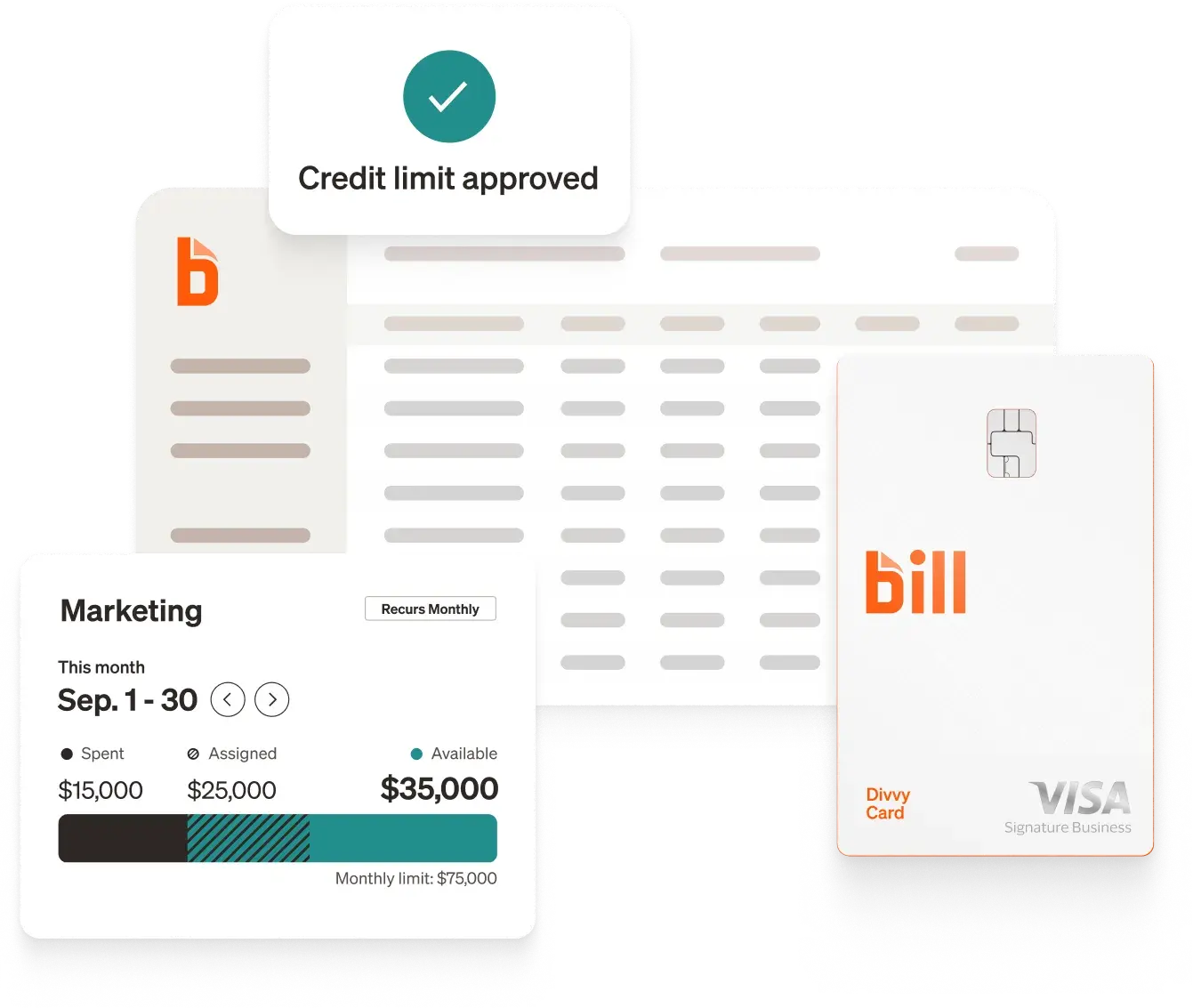
BILL Spend & Expense
Best for AI expense automation
4.5 on G2
  • Smart corporate cards with real-time tracking, flexible limits, and instant visibility into every transaction across your team [1]
  • Unlimited free virtual cards with unique numbers for each vendor or subscription—freeze, delete, or set custom limits instantly to prevent overcharges and reduce fraud risk [5]
  • AI-powered auto-categorization and receipt matching that connects card transactions and expenses into a single reconciliation workflow [1]
  • Customizable budgets with spend controls based on merchant, amount, receipt requirements, and configurable approval workflows [3]
  • Auto-freeze on cards with incomplete transactions, ensuring receipts and documentation are captured before additional spend is approved [1]
  • Up to 7x points on restaurants, 5x on hotels, 2x on recurring software, and 1.5x on all other purchases (rates shown are for weekly or daily billing cycle; rates vary by billing frequency) [2]
  • Two-way sync with QuickBooks, NetSuite, Sage Intacct, Xero, and Microsoft Dynamics; additional integrations with Acumatica, Slack, and HRIS platforms [1]
  • Lorem ipsum dolor sit amet: At pretium eget vel non sed integer nibh neque auctor. Massa est et eu dolor a mauris ut at in.
  • Lorem ipsum dolor sit amet: At pretium eget vel non sed integer nibh neque auctor. Massa est et eu dolor a mauris ut at in.
  • Lorem ipsum dolor sit amet: At pretium eget vel non sed integer nibh neque auctor. Massa est et eu dolor a mauris ut at in.
  • Lorem ipsum dolor sit amet: At pretium eget vel non sed integer nibh neque auctor. Massa est et eu dolor a mauris ut at in.
  • Lorem ipsum dolor sit amet: At pretium eget vel non sed integer nibh neque auctor. Massa est et eu dolor a mauris ut at in.
Pricing
$0/user/month with no annual fee
Integrations
Two-way sync with QuickBooks, NetSuite, Sage Intacct, Xero, and Microsoft
Ideal company size
SMB to mid-market
SAP Concur
Best for large enterprises
4 on G2
  • AI-powered receipt capture via ExpenseIt on the SAP Concur mobile app, with smart matching that combines credit card charges and e-receipts into expense reports automatically [7]
  • Configurable approval workflows with built-in audit rules that flag policy exceptions, plus optional Intelligent Audit and Verify add-ons for automated compliance checks [6][7]
  • Modular product suite: Concur Expense, Concur Travel, and Concur Invoice are separate products that can be purchased individually or together, so organizations can start with expense management and add capabilities over time [6]
  • Bank card feed integrations that import corporate card transactions directly into expense reports for automatic reconciliation [6]
  • Joule, SAP's AI assistant, for expense report review, spend analysis, and cost estimation [6]
  • Budget tracking and monitoring tools that give finance teams visibility into spend against departmental or project-level budgets [6]
  • Support for global operations with multi-currency expense reporting and country-specific tax and regulatory compliance tools [6]
  • Pro: 300+ pre-built integrations including native SAP ERP sync [7][8]
  • Pro: Global coverage with multi-currency and regulatory compliance tools [6]
  • Pro: Modular—add travel or invoice management without switching platforms [6]
  • Pro: AI-powered receipt capture and smart matching via ExpenseIt [7]
  • Con: Quote-based pricing; no published rates on the website [6]
  • Con: No corporate card offering; relies on bank card feed integrations [6]
  • Con: Implementation can be complex for smaller organizations [6]
  • Con: Live support requires purchasing the User Support Desk service [6]
Pricing
Quote-based
Integrations
QuickBooks, Xero, Sage,TSheets, Gusto, & most business credit cards.
Ideal Company Size
Mid-market to enterprise
Ramp
Best for a broad spend platform
4.8 on G2
  • Corporate cards with customizable spend controls by merchant, category, employee, or department, plus unlimited virtual and physical cards [9][10]
  • AI-powered receipt matching, transaction coding, and memo suggestions that auto-populate as soon as a card is swiped [9]
  • Policy agent that reviews every expense against company policy, auto-approves compliant transactions, and escalates only exceptions with full audit trail [9]
  • Expense submission via SMS, Slack, or Microsoft Teams in addition to web and mobile app [9]
  • Reimbursements for out-of-pocket expenses paid to employees' bank accounts in 1–2 business days [9]
  • Real-time spend reporting with custom dashboards, natural-language queries, and proactive overspend alerts [9]
  • Broader spend platform that includes AP automation, procurement, vendor management, and treasury alongside expense management [9]
  • Pro: Free plan includes corporate cards, expenses, and bill pay [11]
  • Pro: AI policy agent reviews 100% of expenses automatically [9]
  • Pro: Submit expenses via SMS, Slack, or Teams—no app required [9]
  • Pro: Broader spend platform covers AP, procurement, and vendor management [9]
  • Con: Budget tracking requires Ramp Plus at $15/user/month [11]
  • Con: NetSuite, Sage Intacct, and Dynamics integrations require a paid plan [11]
  • Con: HRIS syncs and auto-lock cards require a paid plan [11]
  • Con: Credit limits fluctuate daily based on connected bank balance [12]
Pricing
$0/user/month
Integrations
QuickBooks, NetSuite, Xero, Sage Intacct, Slack, & 100+ accounting tools.
Ideal Company Size
Startups to mid-market
Brex
Best for global teams
4.8 on G2
  • Corporate cards with customizable spend limits by role, department, or category, plus auto-approve for in-policy expenses and auto-decline for out-of-policy spend [13][14]
  • AI-powered expense reviews that auto-approve compliant transactions and surface only exceptions for human review, with clear visibility into why a transaction is flagged [13]
  • Auto-generated receipts and memos with OCR that matches receipts in any language or currency, plus automatic GL coding by department, project, and entity [13]
  • Live Budgets that let department heads set top-level budgets, provision spend to individuals or teams, and track usage in real time with anomaly detection [13]
  • Global reimbursements in 70+ countries in employees' local currency, with subsidiaries able to issue reimbursements from local bank accounts [13]
  • Expense submission and approval via Slack and WhatsApp, with in-app commenting on individual transactions [13]
  • Broader financial platform that includes bill pay, business banking with up to 3.68% yield, and treasury alongside expense management [14]
  • Pro: Free plan includes corporate cards, expenses, bill pay, and travel [15]
  • Pro: AI expense reviews with 99% average policy compliance rate [14]
  • Pro: Global reimbursements in 70+ countries in local currency [13]
  • Pro: Live Budgets with real-time tracking and anomaly detection [13]
  • Con: Live Budgets require Premium at $12/user/month [15]
  • Con: HRIS syncs and customizable ERP integrations require a paid plan [15]
  • Con: Credit limits fluctuate daily based on connected bank balance [16]
  • Con: Multiple expense policies and dynamic review chains require Premium [15]
Pricing
$0/user/month
Integrations
NetSuite, QuickBooks, Workday,SAP Concur, Slack, & global banking portals.
Ideal Company Size
Startups to mid-market
Expensify
Best for simple reimbursements
4.5 on G2
  • SmartScan receipt capture by photo, email forwarding (receipts@expensify.com), or text message; auto-extracts transaction details and categorizes expenses [17]
  • Bring-your-own-card support: link existing corporate cards from 10,000+ banks globally for automatic reconciliation without switching card providers [17]
  • Expensify Visa Commercial Card with cash back on US purchases; cash back first offsets the Expensify subscription cost, then flows to the company's bank account [17]
  • Concierge AI for automated expense categorization, policy violation flagging, rule enforcement, and error reduction [17]
  • Global reimbursements for employees and independent contractors in their local currency [17]
  • Chat-based collaboration directly on individual expenses to resolve questions in real time rather than through email follow-ups [17]
  • 45+ integrations including QuickBooks, NetSuite, Sage Intacct, Xero, Workday, and Gusto [17]
  • Pro: Bring-your-own-card from 10,000+ banks globally [17]
  • Pro: Expensify Card cash back can offset the subscription cost [17]
  • Pro: SmartScan receipt capture by photo, email, or text message [17]
  • Pro: 45+ integrations including major ERPs and payroll systems [17]
  • Con: No free plan; starts at $5/user/month [18]
  • Con: Pricing structure varies by card spend volume [18]
  • Con: Budget management, advanced approvals, and expense policies require Collect or Control plans [17]
  • Con: No department-level budget management on par with card-first platforms
Pricing
From $5/user/month
Integrations
QuickBooks, Xero, Sage, TSheets, Gusto, & most business credit cards.
Ideal Company Size
Small to mid-market
Zoho Expense
Best for budget-conscious teams
4.5 on G2
  • Autoscan receipt capture with OCR that auto-categorizes and itemizes each expense, plus the ability to split or tag expenses across departments, projects, or cost centers [19][20]
  • Automated per diem calculations with pre-defined rules based on country, location, and trip details for regional compliance [20]
  • Corporate card management with real-time feeds that automatically match transactions to uploaded receipts for faster reconciliation [20]
  • Mileage tracking with four input methods across Android, iPhone, and Apple Watch [20]
  • Configurable approval workflows, expense policies, and audit rules with detailed audit trails for compliance [19][20]
  • Custom modules, workflow automation, webhooks, and configurable UI elements for businesses that need tailored expense processes [19]
  • Active-user pricing model: only employees who actually create expenses are charged, so admins and approvers who don't submit reports are free [21]
  • Pro: Free plan available for up to 3 users with core expense tracking [21]
  • Pro: Active-user pricing—admins and approvers aren't charged [21]
  • Pro: Automated per diem calculations by country and location [20]
  • Pro: Deep customization with custom modules and workflow automation [19]
  • Con: Corporate card feeds and multi-level approvals require Standard plan [21]
  • Con: Deepest value requires the broader Zoho ecosystem (Books, People, CRM) [19]
  • Con: No corporate card offering; relies on connecting existing cards [20]
  • Con: Travel booking, per diem, and live budgets require Premium plan [21]
Pricing
Free (3 users); from $4/user/month
Integrations
Zoho Books, QuickBooks, Xero, Sage, Microsoft Dynamics, & Google Workspace.
Ideal Company Size
Small to mid-market